The Suffocation of The All-Or-Nothing Marriage: Climbing Mount Maslow Without Enough Oxygen

Americans now expect marriages to fulfill higher-level needs, requiring significant time and effort (oxygen). Most couples invest less than before, leading to lower marital quality and well-being, and in doing so, the suffocate as they try to climb Mount Maslow. Drawing by Brian Nwokedi
"Contemporary Americans are asking their marriage to help them fulfill different sets of goals than in the past. In the past, they asked their marriage to help them fulfill their psychological and safety needs. Now, they ask their marriages to fulfill their esteem and self-actualization needs, and they do so without sufficient investment of time, psychological resources, or "oxygen." 
--- Eli J. Finkel (2017)
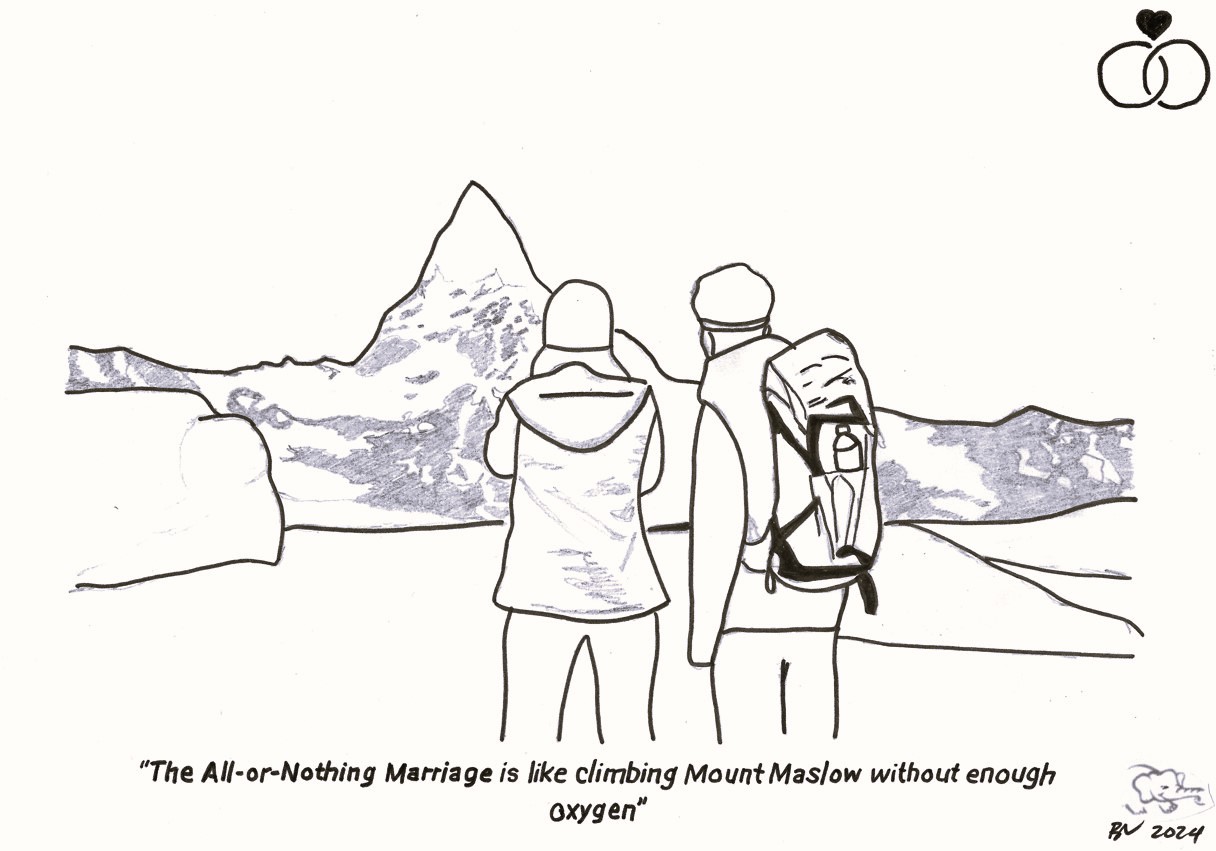
Americans now expect marriages to fulfill higher-level needs, requiring significant time and effort (oxygen). Most couples invest less than before, leading to lower marital quality and well-being, and in doing so, the suffocate as they try to climb Mount Maslow.

📚 Core Insight

  • Modern marriage has shifted from a pragmatic survival institution to a high-altitude self-actualization platform — demanding more emotional, psychological, and existential fulfillment than ever before.
  • As expectations for marriage have climbed, the investment of time, attention, and psychological energy needed to sustain it has declined — creating an “oxygenation gap” at the summit.
  • The greatest modern marriages are built not by those who seek constant bliss, but by those who modulate expectations, invest deliberately, and accept that even peak experiences require periods of patient recalibration.
  • Thriving in the era of the all-or-nothing marriage demands flexibility, resilience, and the willingness to continually re-supply the relationship with emotional “oxygen” — or risk suffocation at the summit.

On average, we as a society are investing less time in our marriages than in the past. As a result, mean levels of marital well-being is declining over time. Spouses are struggling with what they are asking from their marriage and what they are investing in it.

In his 2017 book, The All-or-Nothing Marriage, Eli J. Finkel investigates how the dynamics and expectations on marriage in America have changed since roughly the colonial times. These changes mirror Abraham Maslow’s hierarchy of needs, as American marriages transitioned from the fulfillment of lower needs, to higher needs like self-actualization.

Success at these higher altitudes require a significant level of investment in time and energy … One that not every participant in modern marriages has willingly made or adapted to.

In short, modern marriages are tougher than they have historically been given that economic progress and industrialization have made it easier to live alone, especially when compared to colonial times of the 1700s. And in short, this fact has made us require/request more from our marriages leading to a very large expectations gap that Finkel calls the All-or-Nothing Marriage.

Downloadable Content – Raw Notes

Interested in diving deeper into Eli J. Finkel’s work on The All-or-Nothing Marriage? Download my unfiltered notes below ?
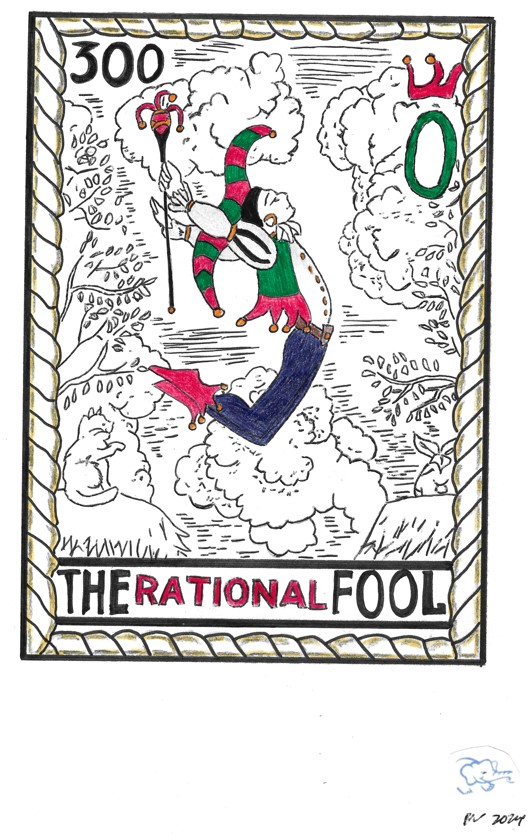
The “Rational Fool” Inspired by Richard Thaler’s Misbehaving

"People who always give nothing are rational fools who blindly follow material self-interest." --- Richard Thaler (2016)
The "Rational Fool" by Brian Nwokedi serves as a whimsical yet thought-provoking representation of the human tendency to act against our own best interests despite possessing rational capabilities. This concept, rooted in behavioral economics, challenges the traditional economic assumption of humans as perfectly rational decision-makers. This drawing aims to spark curiosity and discussion around the fascinating intersection of psychology and economics, highlighting the importance of understanding behavioral biases in our everyday lives. Through this playful visual metaphor, the Rational Fool invites visitors to explore the intriguing complexities of human behavior and decision-making, ultimately encouraging a deeper appreciation for the nuances of our choices.

📚 Core Insight

  • Driven by heuristics, emotional biases, and short-sighted impulses, people consistently deviate from “rational” behavior in predictable patterns.
  • Success in leadership, business, and investing doesn’t come from maximizing cold logic alone — it requires understanding and anticipating these very human misbehaviors.
  • Those who blindly optimize for material self-interest — the true “rational fools” — often miss the deeper structures of trust, cooperation, and adaptive success.

Inspired by Richard Thaler’s Misbehaving: The Making of Behavioral Economics, the “Rational Fool” serves as a whimsical yet thought-provoking representation of the human tendency to act against our own best interests despite possessing rational capabilities. This concept, rooted in behavioral economics, challenges the traditional economic assumption of humans as perfectly rational decision-makers.

This drawing aims to spark curiosity and discussion around the fascinating intersection of psychology and economics, highlighting the importance of understanding behavioral biases in our everyday lives.

Through this playful visual metaphor, I invite visitors to explore the intriguing complexities of human behavior and decision-making, ultimately encouraging a deeper appreciation for the nuances of our choices.

Downloadable Content – Raw Notes

Interested in diving deeper into Richard Thaler’s work on Misbehaving? Download my unfiltered notes below ?
The Psychology of Money

"Success with money relies more on Psychology than Finance,and doing well with money has little to do with how smart you are, and a lot to do with how you behave. And behavior is hard to teach, even to really smart people." --- Morgan Housel (2020)

📚 Core Insight

  • Success with money is about behavioral discipline, not technical intelligence.
  • Smart people fail financially because behavior > IQ when it comes to money.
  • Emotional control, patience, decision-making matter more than financial formulas.

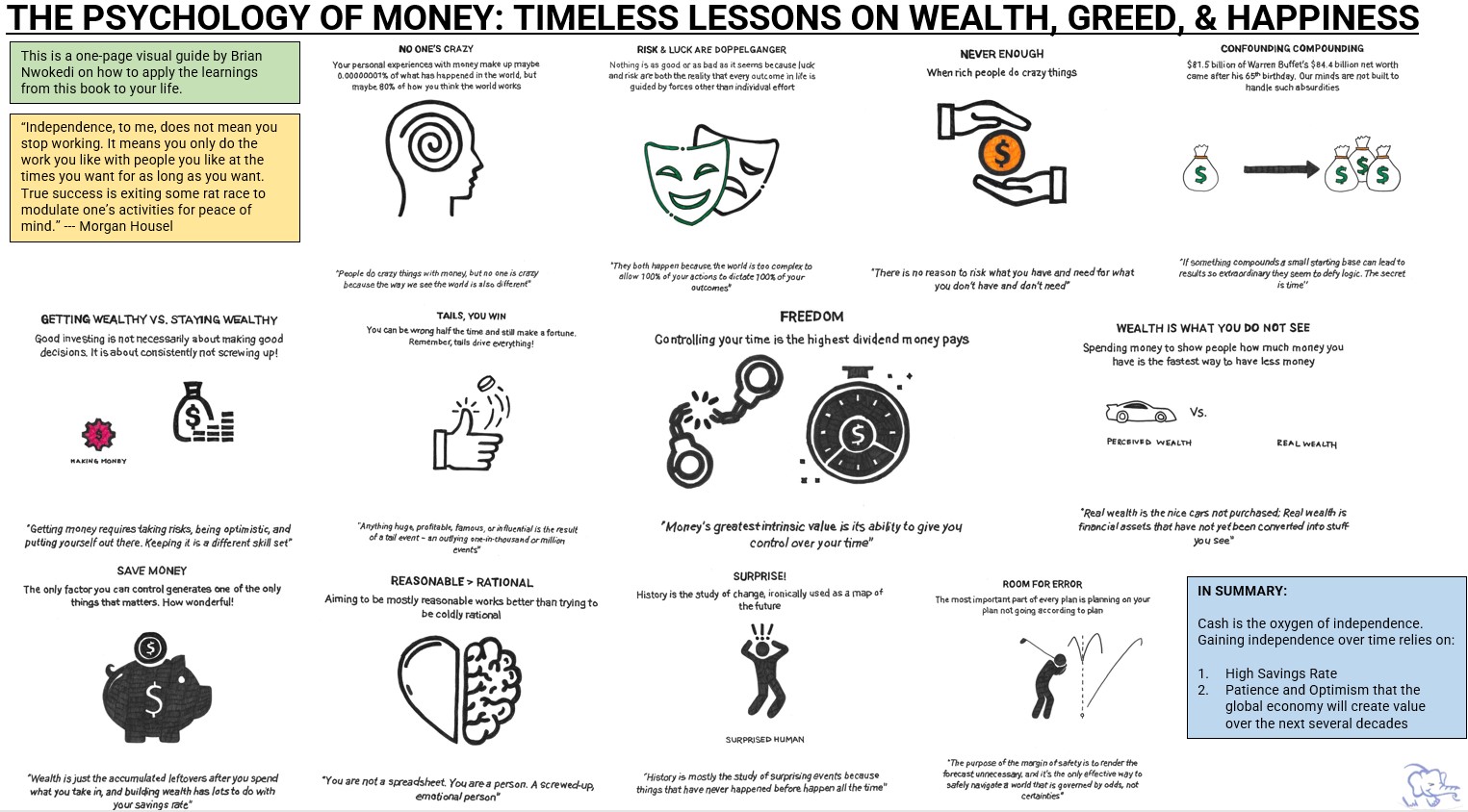
The Psychology of Money by Morgan Housel is an insightful guide that puts the spotlight of financial success squarely on the shoulders of human behavior. In this world of complexity, how you behave with money is more important than what you know about money.

With a blend of research, anecdotes, and stories of personal experiences, Housel illuminates the significance of better understanding your own behavior, and how that is far more responsible for your financial outcomes than your skill.

The following one-page visual guide has been created by me to help you apply the teachings from Morgan’s book to your life. See below ?

Downloadable Content – Raw Notes

Ready to dive deeper into Morgan Housel’s work on The Psychology of Money? Download my unfiltered notes below ?
Everything You Need To Know About Saving For Retirement

“However, I am confident in saying that if you can figure out a way to save 10% to 20% of your income into the financial markets each year, automate your savings and all of your bill payments, increase the amount you save each year by just a little, diversify your investments, and basically leave them alone, you will be better off financially than the vast majority of retirement savers in America. Everything else is gravy.” --- Ben Carlson (2020)

📚 Core Insight

  • Building financial independence isn’t about complex investment strategies — it’s about mastering simple behaviors consistently over decades.
  • The real drivers of retirement success are: saving early and often, automating your habits, resisting lifestyle inflation, and focusing relentlessly on what you can control (your savings rate and behavior) — not chasing high investment returns.
  • Patience, discipline, and consistency—not brilliance—win the long game.

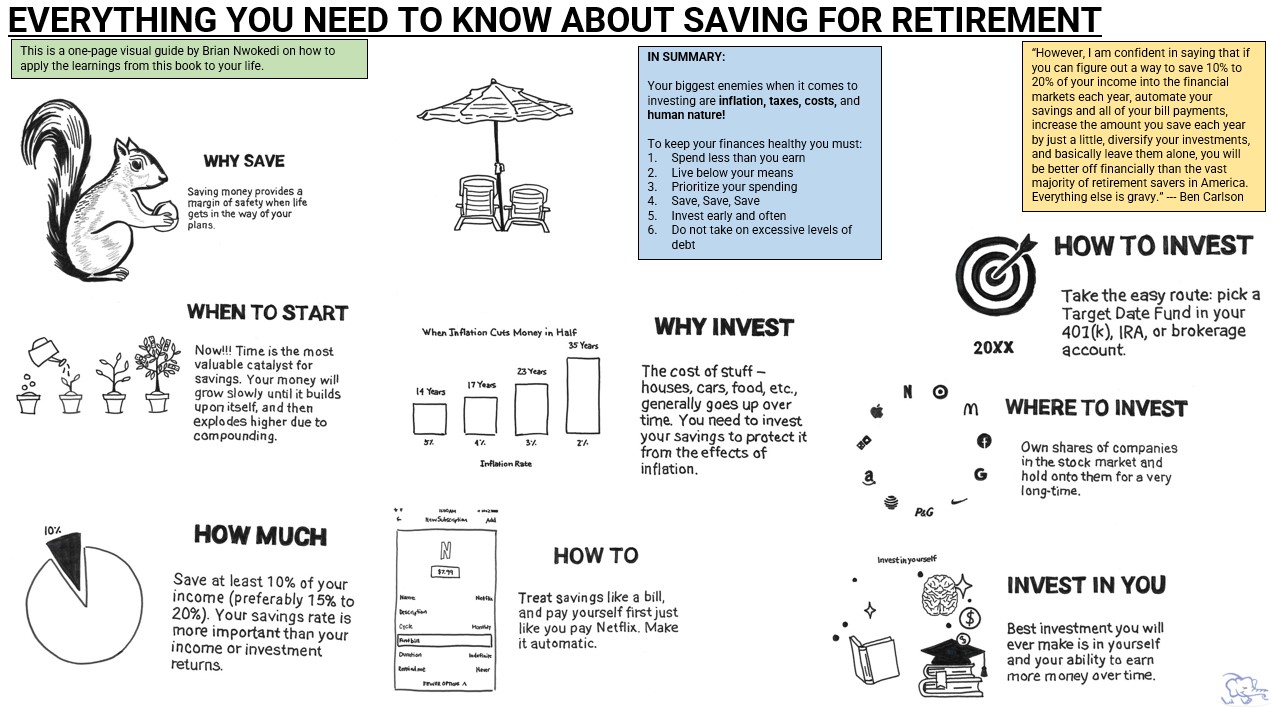
Everything You Need to Know About Saving for Retirement by Ben Carlson is a succinct yet insightful guide that puts the spotlight on a fundamental aspect of retirement planning: your savings rate. In a world of complex investment strategies and ever-changing financial landscapes, Carlson distills his wisdom into a straightforward message – it’s not just about where you invest, but how much you save.

With a clear and approachable style, he emphasizes that building a secure retirement is within reach if you focus on increasing your savings and maintaining a consistent approach. Drawing on his expertise in personal finance, Carlson’s concise and no-nonsense approach empowers readers to take control of their financial destinies, offering a roadmap to achieving financial security during retirement through a smart savings strategy!

The following one-page visual guide has been created by me to help you apply the teachings from Ben’s book to your life. See below ?

This one-page visual guide by Brian Nwokedi has been created to help you apply the learning from Ben Carlson's book to your life.

Downloadable Content – Raw Notes

Ready to dive deeper into Ben Carlson’s work on Saving for Retirement? Download my unfiltered notes below ?
Steve Young: An Example of a Paragon of GRIT

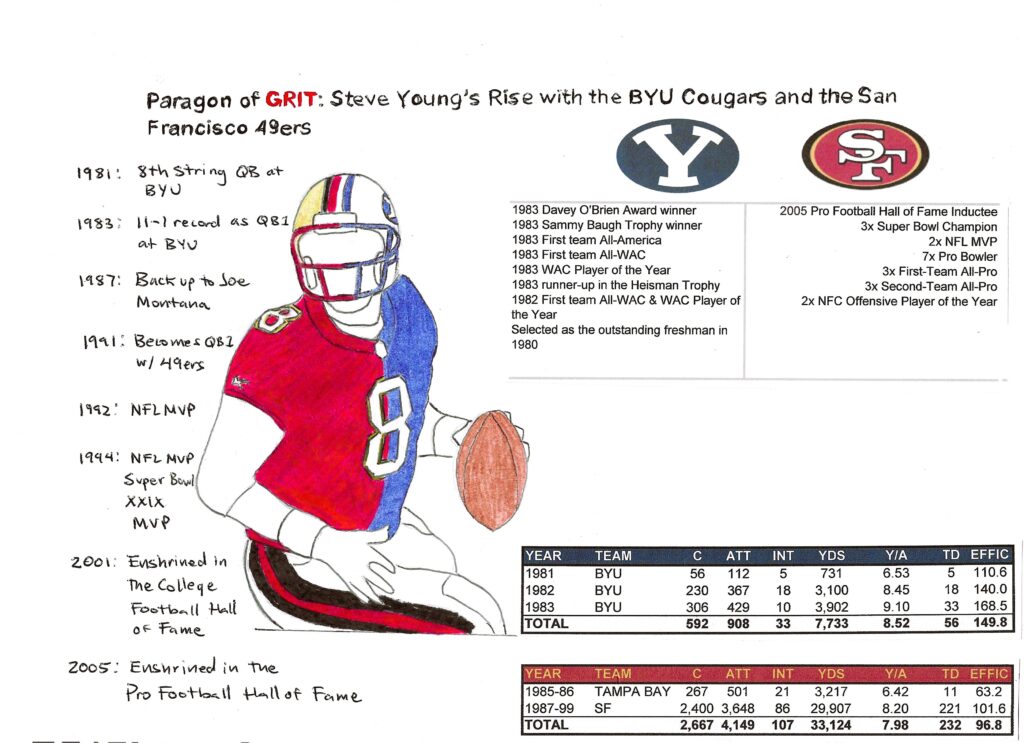
You cannot quit. You have the ability, so you need to go back and work this out.” - Steve Young’s Dad, (circa 1980s)
Drawing by Brian Nwokedi to explain the characteristics of a GRIT paragon
Steve Young: A Gridiron Paragon of Grit. From every touchdown to each hard-fought comeback, his relentless determination on the field defines the true essence of grit. A quarterback icon who faced challenges head-on, Young embodies the spirit of unwavering passion and perseverance.

📚 Core Insight

  • Success is rarely about raw talent — it’s about relentless passion, perseverance, and purpose.
  • Angela Duckworth’s research shows that grit — sustained effort over years, even decades — outpaces natural ability.
  • In leadership, sports, and life, greatness is the result of thousands of ordinary efforts compounded over time, fueled by belief, practice, resilience, and a clear sense of purpose.
  • Grit isn’t a fleeting burst of effort — it’s a culture you build within yourself and, eventually, within the teams you lead.

Steve Young is the epitome of a GRIT Paragon. When he was a freshman at BYU, he was the 8th string quarterback and was barely even getting any practice time. Like most freshmen when things don’t go according to plan, Steve called his father (whose nickname was actually Grit). 

Steve’s dad basically said the following: “You can quit but you can’t come home because I’m not going to live with a quitter. You’ve known that since you were a kid. You’re not coming back here.”

With the words of his father ringing in his ears, Steve Young stepped up his game and put the work in. By all accounts, he threw over 10,000 spiral passes at a practice net the summer between his freshman and sophomore year. By his sophomore year, he had risen to QB2 and by his junior year he was BYU’s starting QB. In his final year with the Cougars, Steve Young won the Davey O’Brien award for the most outstanding college quarterback in the country.

Then … It happened all again when he got to the San Francisco 49ers. He spent 4 years on the bench as the backup to four-time Superbowl champion, Joe Montana. And because of his experience at BYU, Steve stayed, learned, and flourished under Montana’s apprenticeship. He eventually got his chance and the rest is history.

When Steve Young retired, he was the highest-rated quarterback in NFL history.

Luis Figo: Real Madrid’s Change Agent

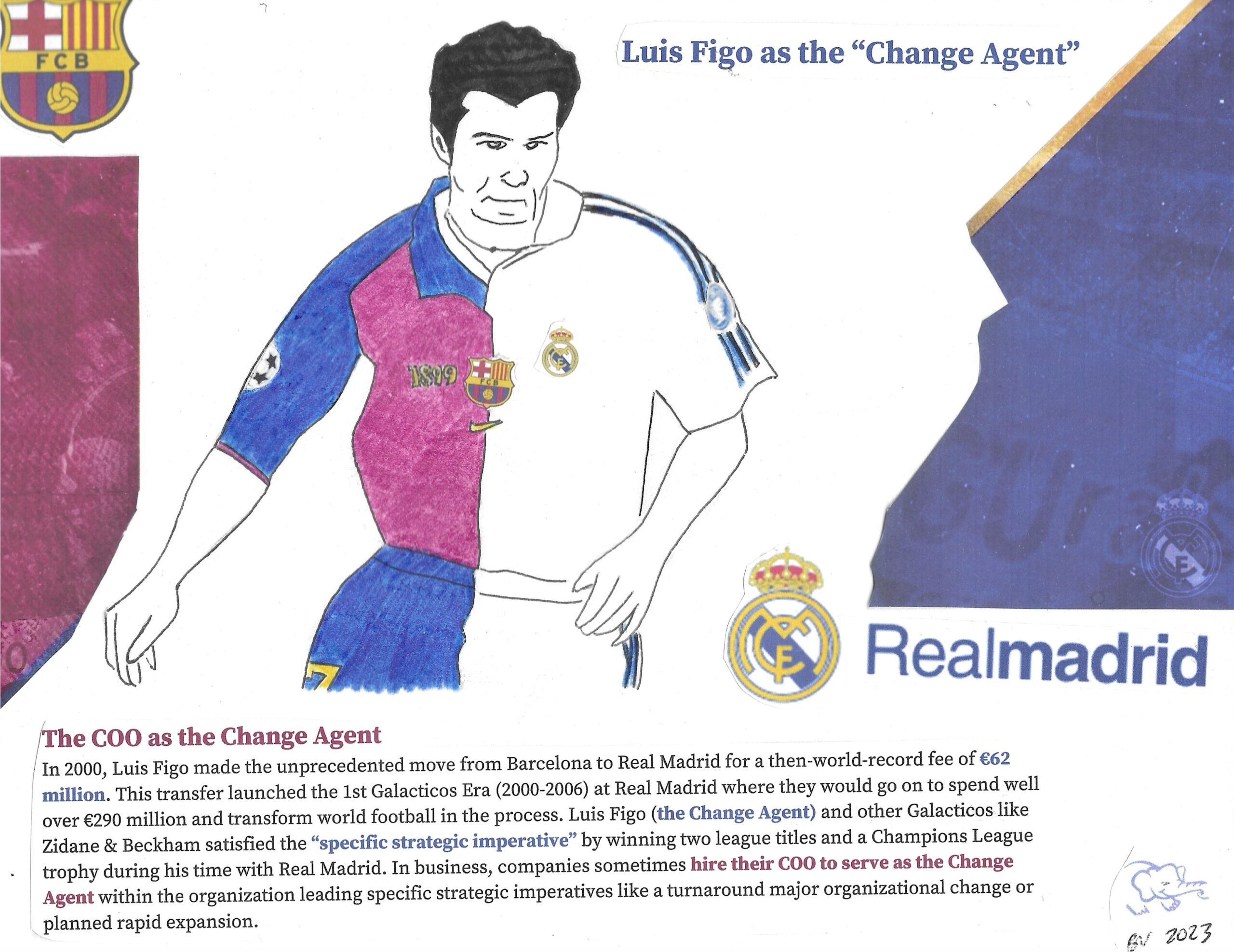
Luis Figo Served as Real Madrid’s Change Agent During the First Era of the Galácticos
Drawing by Brian Nwokedi to explain the purpose of a strong COO and CEO relationship

In 2002, Luis Figo emerged as the winner of the prestigious Ballon d’Or, recognizing him as the top football player in Europe. This accolade came shortly after his controversial transfer from Barcelona to their arch-rivals, Real Madrid.

Figo’s move to Real Madrid marked him as the chosen Change Agent by Florentino Pérez, who aimed to usher in an era of high-profile, world-class superstars. The 62 million euro transfer fee was just the beginning of a series of extravagant signings from 2000 to 2006, during which Madrid spent well over 290 million euros.

Over his five-year tenure with Real Madrid, Figo made a significant impact, with over 200 appearances and notable triumphs, including two league titles and the 2002 Champions League. His arrival injected new vitality into Los Blancos, albeit at the expense of his former club in Catalonia. Organizations often require a COO to serve as a Change Agent, focusing on implementing specific organizational changes. In this role, the COO spearheads initiatives such as turnarounds, major organizational transformations, or planned rapid expansions, while the CEO maintains the day-to-day operations. When executed effectively and in balance, this approach can lead to remarkable progress and success.

Scottie Pippen: The Co-Leader to Michael Jordan

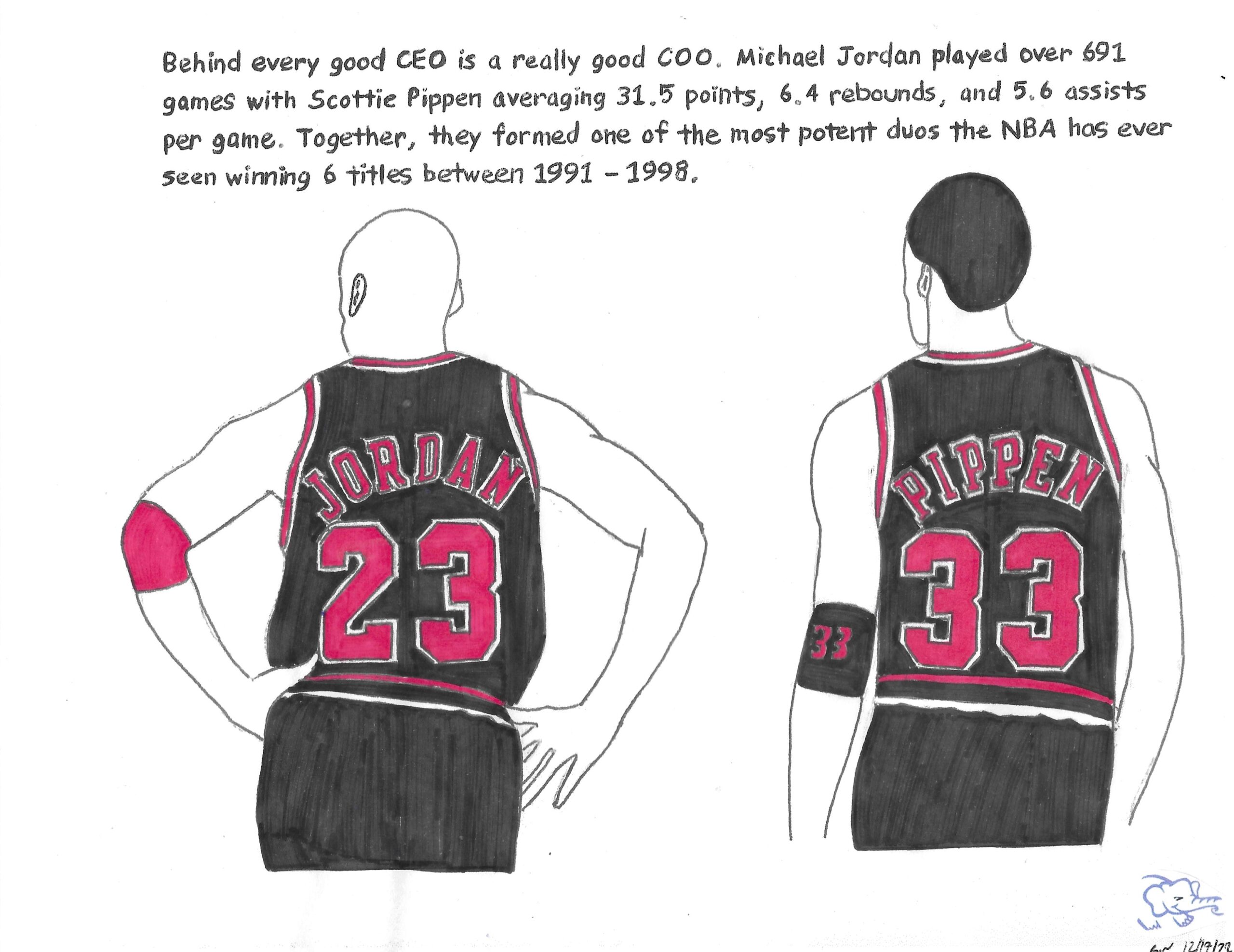
Michael Jordan and Scottie Pippen Formed a Strong Two-In-A-Box Partnership During Their 10-Year Run at the Top of the NBA
Drawing by Brian Nwokedi to explain the purpose of a strong COO and CEO relationship

Michael Jordan and Scottie Pippen established an extraordinary and cohesive Co-Leader partnership during their dominant ten-year reign atop the NBA that ended in historic double three-peats. Throughout their intertwined careers, Jordan and Pippen exemplified the essence of a Two-In-a-Box partnership. Their collaboration on and off the court showcased remarkable synergy, mutual understanding, and shared goals. Pippen’s exceptional abilities, combined with Jordan’s unparalleled talent, propelled the Chicago Bulls to unprecedented success, and Pippen flawlessly assumed the role of Michael Jordan’s Co-Leader.

Their dynamic duo not only achieved individual greatness but also fostered a collective strength that elevated the entire team. Together, they formed one of the most electrifying and potent duos ever witnessed in the NBA. In drawing parallels to the COO’s role, Jordan and Pippen’s Co-Leader partnership exemplifies the power of a collaborative approach. By working together, leveraging their respective strengths, and nurturing a harmonious relationship, they propelled the Bulls to the pinnacle of the NBA. The impact of such a Co-Leader dynamic extends beyond basketball, highlighting the significance of a strong and complementary partnership in driving organizational success.

Venus Williams: The Mentor to Serena Williams

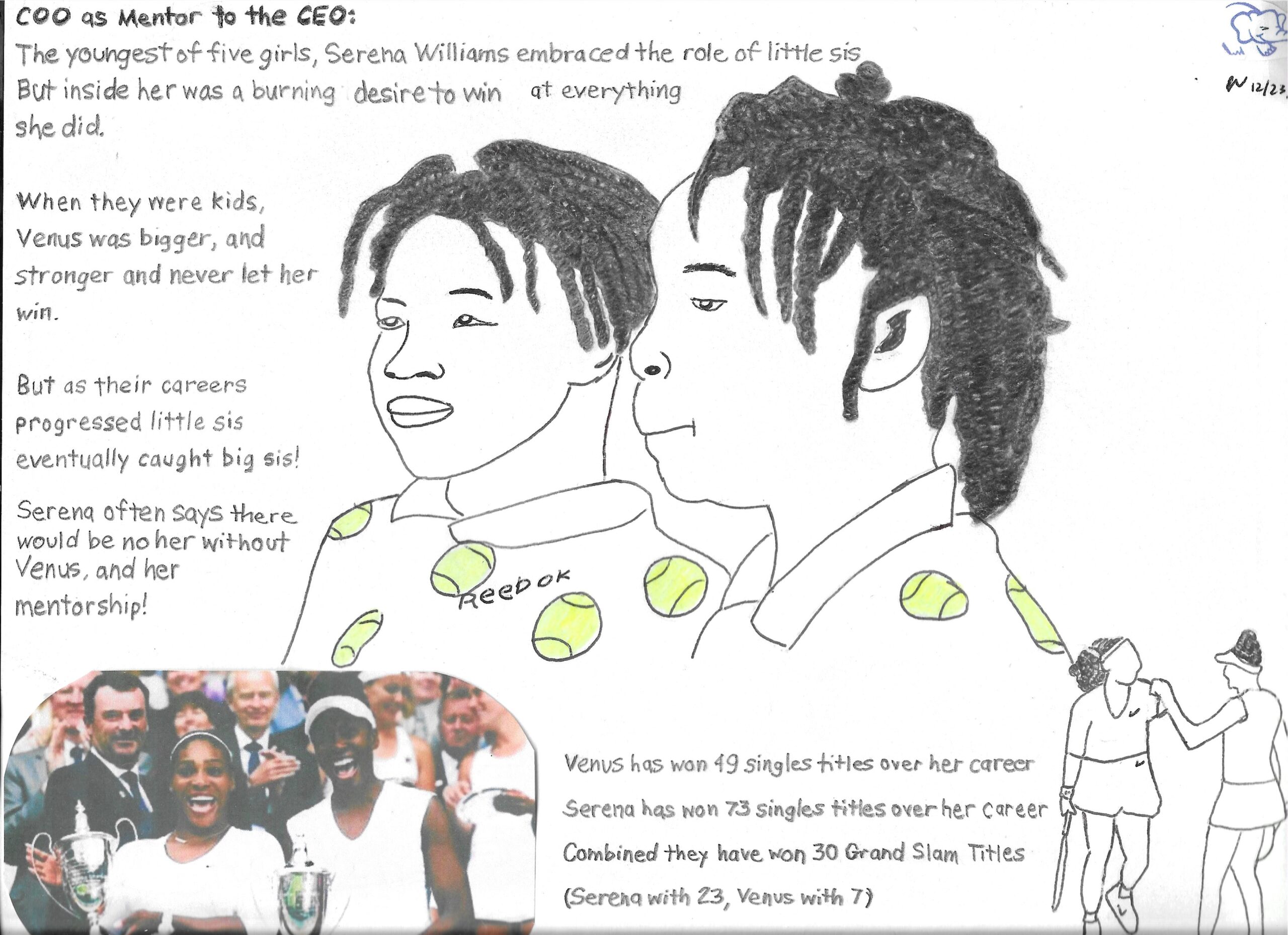
Venus Williams and Serena Williams Formed a Strong Mentorship CEO-COO Relationship During Their past 25 years on the court
Drawing by Brian Nwokedi to explain the purpose of a strong COO and CEO relationship

Venus Williams stands as one of the most compelling examples of mentorship in the world of tennis. Serena Williams herself acknowledges that her journey would not have been possible without Venus, but I believe the impact goes even further. The influence of Venus extends to players like Coco Gauff, Naomi Osaka, Sloane Stephens, and Madison Keys, who have all been inspired by her trailblazing presence.

Venus brought a new era to tennis with her remarkable speed, distinctive style, and unapologetic confidence. However, her role as a Big Sister went beyond her on-court achievements. She served as a mentor, shielding Serena from the resistance of the tennis establishment and the pervasive racism that often accompanied their rise to stardom.

This mentoring dynamic can be likened to the role of a Chief Operating Officer (COO) in the business world. In both cases, the mentor figure provides guidance, support, and protection, empowering their mentee to navigate obstacles and reach their full potential. Venus’s mentorship not only elevated Serena’s career but also paved the way for future generations of tennis players, exemplifying the transformative impact of a dedicated mentor, both on an individual and broader scale.

Patrick Mahomes: The Heir Apparent to Alex Smith

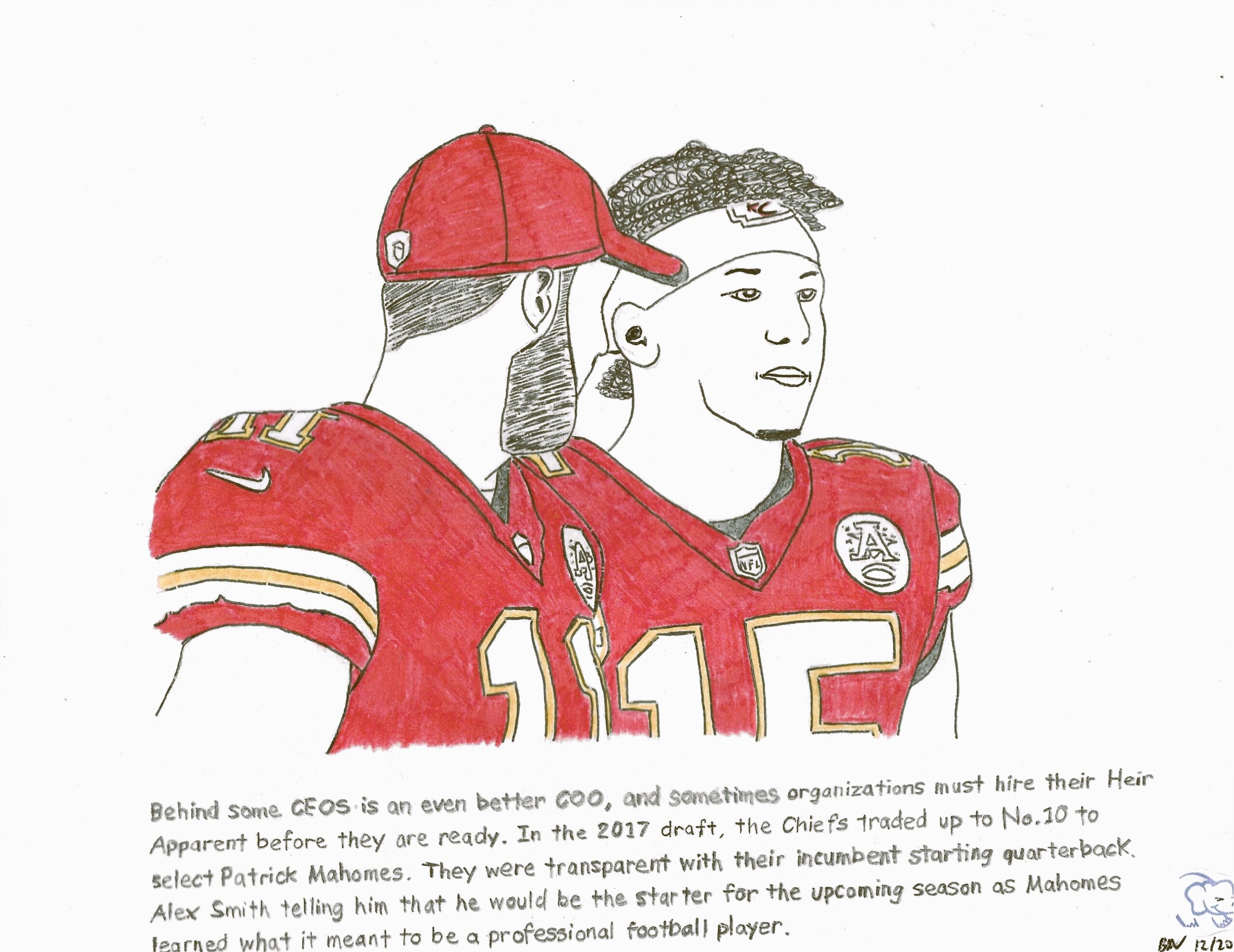
Alex Smith and Patrick Mahomes Formed a Strong Heir-Apparent CEO-COO Relationship During the 2017 Season with the Kansas City Chiefs
Drawing by Brian Nwokedi to explain the purpose of a strong COO and CEO relationship

During his tenure from 2013 to 2017, Alex Smith served as the starting quarterback for the Chiefs, leading the team to the playoffs on four occasions and securing their first playoff victory in over two decades. However, in 2017, the Chiefs made a strategic decision to trade up and select Patrick Mahomes as Smith’s long-term successor. Coach Andy Reid demonstrated transparency with Smith, providing the reassurance he needed to embrace the role of mentoring Mahomes. Just a year later, Smith was traded, paving the way for Mahomes to step in as the new starting quarterback. This scenario exemplifies the Heir-Apparent CEO-COO structure, which can be instrumental in ensuring successful succession planning.

In this context, the COO plays the role of the Heir Apparent. Similar to the quarterback transition, the COO is identified and groomed as the successor to the CEO. By implementing a well-executed Heir-Apparent CEO-COO structure, organizations can facilitate a seamless transition of leadership. The COO, under the mentorship and guidance of the CEO, gains valuable experience, insights, and knowledge necessary to assume the top role when the time comes. This strategic approach allows for continuity in leadership and ensures that the organization can thrive even during leadership changes.

Ed Reed: The Trusted Partner to Ray Lewis

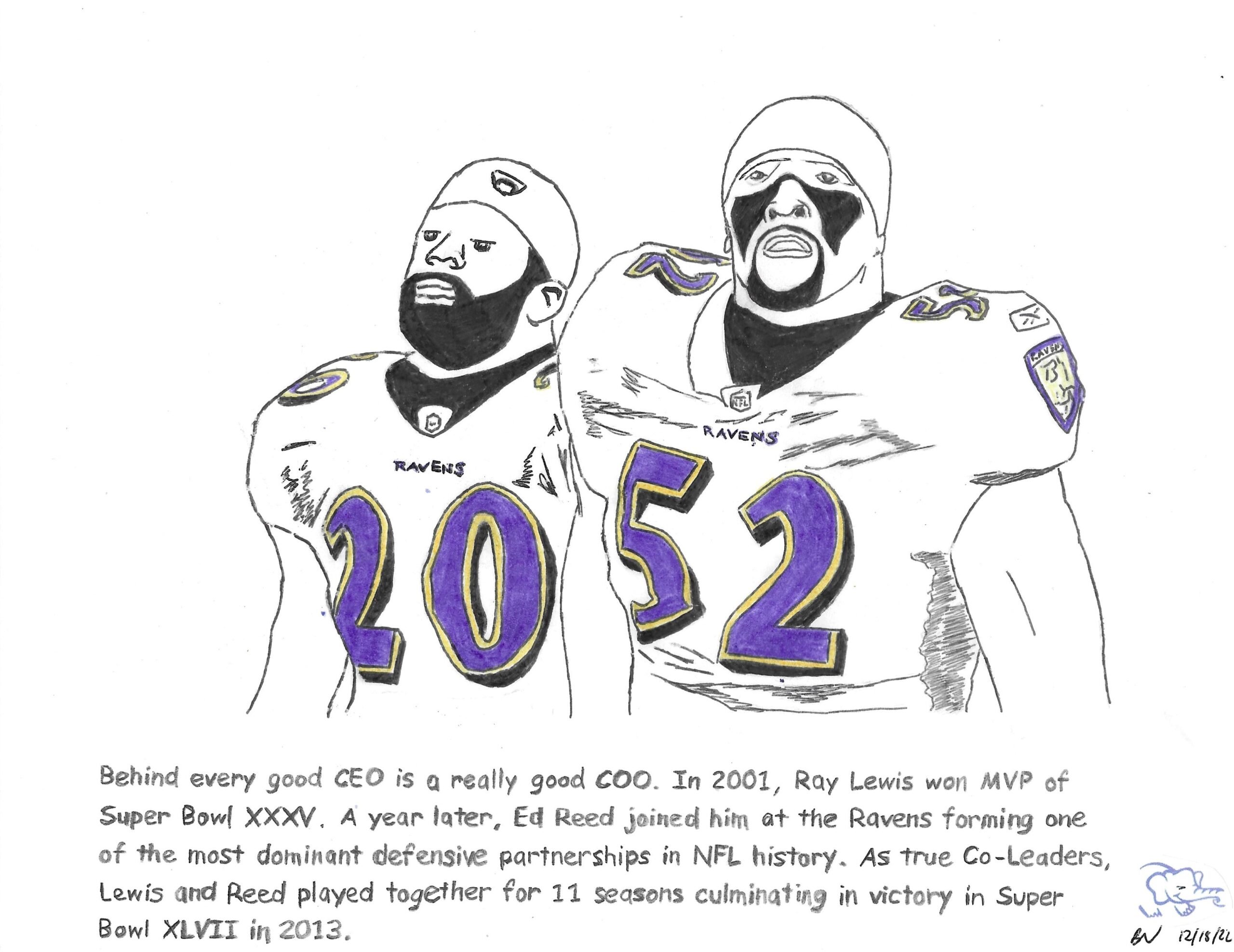
Ray Lewis and Ed Reed Formed a Strong Co-Leader Partnership During Their 11-Year Run with the Baltimore Ravens
Drawing by Brian Nwokedi to explain the purpose of a strong COO and CEO relationship

During their Super Bowl XLVII-winning campaign in 2013, the Baltimore Ravens showcased their defensive prowess, despite being ranked 12th in total defense. What set them apart was the remarkable partnership between Ray Lewis and Ed Reed. Their collaboration as Co-Leaders began in 2002 and spanned an impressive 11 years, solidifying their status as one of the most formidable linebacker/safety tandems in NFL history. Together, they anchored a consistently outstanding defense that stood among the league’s best.

Ray Lewis and Ed Reed epitomize the essence of a Trusted Partner relationship. Their deep bond and understanding on the field allowed them to anticipate each other’s moves, offering unwavering support and collaboration. With Lewis’s commanding presence and Reed’s exceptional playmaking skills, they formed an unbreakable foundation for the Ravens’ defense. Their synchronized efforts and remarkable synergy elevated their team to new heights.

This Trusted Partner dynamic in football can be likened to the role of a Chief Operating Officer (COO) in the business world. Just as Lewis and Reed established a reliable and cohesive unit, a COO serves as a Trusted Partner to the CEO, fostering a strong partnership at the top. This collaboration ensures a harmonious and effective leadership team, capable of driving the organization towards success. The impact of a Trusted Partner, both in football and business, cannot be understated, and Lewis and Reed’s legacy as an exceptional tandem serves as a testament to the power of such a partnership.