
Introduction
Ben Horowitz’s The Hard Thing About Hard Things is one of the few business books that tells the truth about what it actually feels like to lead under pressure. No formulas. No cheerful frameworks. Just the raw mechanics of surviving decisions that have no good options. The concept that stayed with me longest is one he calls “Give Ground Grudgingly.”
Give Ground Grudgingly
In The Hard Thing About Hard Things,” Ben Horowitz introduces the concept of “Give Ground Grudgingly,” emphasizing maintaining growth while minimizing degradation. This principle advises leaders to make necessary sacrifices but resist unnecessary losses. It’s about finding the balance between expanding the business and preserving its core values and capabilities. Essentially, Horowitz is advocating for cautious and strategic growth, ensuring that as the company evolves, it retains its essential strengths and integrity, thus degrading as slowly as possible.
American Football Analogy
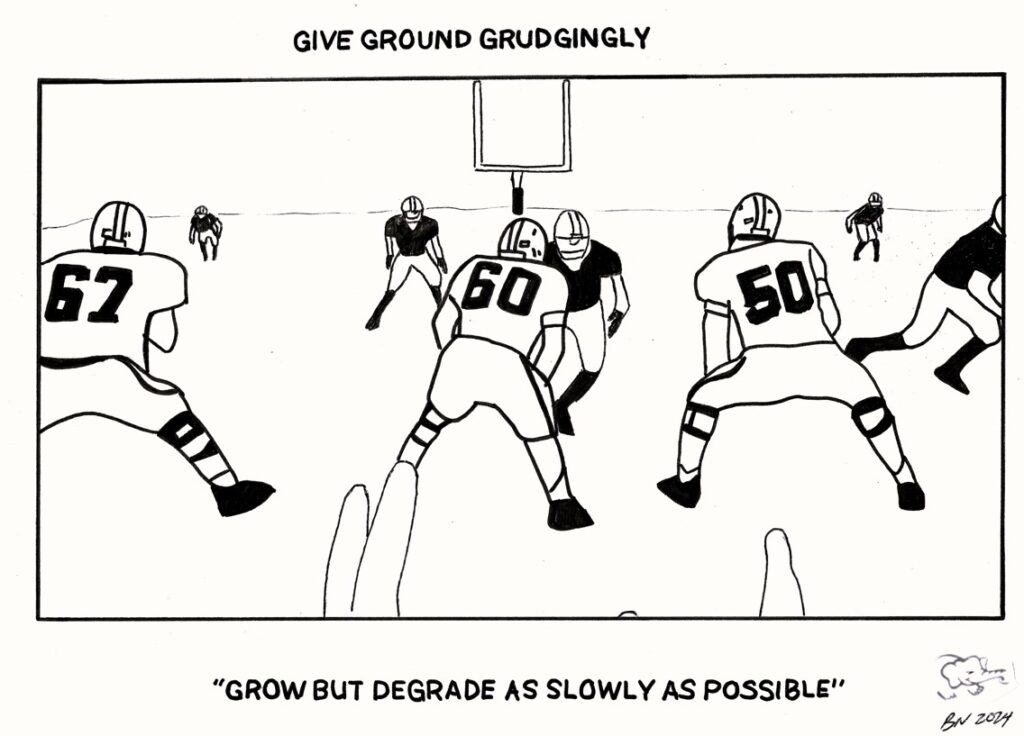
There is a great analog to this concept in American football. An offensive lineman’s job is to protect the quarterback from onrushing defensive linemen. If the offensive linemen attempt to do this by holding their ground, the defensive lineman will easily run around them and crush the quarterback. As a result, offensive linemen are taught to lose the battle slowly or to give ground grudgingly. They are taught to back up and allow the defensive lineman to advance, but just a little at a time.
When you scale an organization, you will also need to give ground grudgingly. Specialization, organizational structure, and process all complicate things, and implementing them will feel like you are moving away from common knowledge and quality communication. It is very much like the offensive lineman taking steps backward. You will lose ground, but you will prevent your company from descending into chaos.
This is the operator’s dilemma in a single phrase. You will lose ground. The question is whether you lose it on your terms or someone else’s. Every scaling decision I have made — adding structure, formalizing process, accepting slower communication — has felt like taking a step backward. The discipline is knowing that the step backward is what keeps you from getting sacked.
Full reading notes available below: