Best Options to Use to Pay for Graduate School

Purpose of this article: to explain some options you have to come up with the funds to go to your dream graduate school.

Overview:

You have just been accepted to graduate school, and while you already know the return on investment is high, you have some questions on how to pay for this. The article below will give you some of the best tactical strategies to come up with the money for graduate school.

Strategy 1: Contact the financial aid officers at your school and ask about Fellowships or Scholarships

Many business schools offer lucrative merit-based and/or need-based fellowship awards, and similar to scholarships, these awards do not need to be repaid. On top of fellowships, most schools offer a number of merit-based and/or need-based scholarships. Eligibility for these awards is based on a variety of factors like previous educational achievement, GMAT or GRE scores, and other career related factors.

The stats show that one of the best schools for fellowships is the Harvard Business School. According to the school’s website, “HBS Fellowships are gifts that do not need to be paid back, and nearly 50% of the class receives a fellowship award. The average HBS Fellowship is approximately $37,000 per year, or $74,000 total. All students are encouraged to apply for an HBS Fellowship after being admitted to the program.”

So regardless of your background and career interests, your best bet toward obtaining one of these lucrative offers is to talk with the financial aid department of your respective school as soon as you apply/know that you are getting in. These awards a typically limited and are given out pretty quickly.

Strategy 2: Borrow smartly from the Federal Government

In order to be eligible for federal loans, you will need to be a U.S. citizen and file a form called the Free Application for Student Aid (FAFSA). Once filled out, this form will give you access to federal student loans. Your options from a federal loan standpoint are:

• Stafford Loans (Federal Direct Unsubsidized Loans)
• Graduate PLUS Loans

The following details the characteristics of each of these federal loans:

Stafford Loans (Federal Direct Unsubsidized Loans)
• You can borrow $20,500 annually and $138,500 max lifetime for non-health fields like business

• You can borrow $41,167 annually and $224,000 max lifetime for health fields

• The interest rate is fixed at 6.0% as of June 1, 2017. New rates will be determined on June 1, 2018

• There is a 1.066% origination fee that is deducted proportionally from the loan disbursements. This means that you will receive less money that the amount you actually borrowed

• This loan is Unsubsidized which means interest accrues during the entire time you are enrolled in school

• You do not need to demonstrate financial need to qualify and you don’t need good credit to obtain

• Repayment of this loan is delayed for 6-month after your gradation date and is ultimately unavoidable unless you are eligible for loan discharge or forgiveness

Graduate PLUS Loans
• You must borrow the full amount ($20,500) of the Stafford Loan first, before borrowing any of the Graduate PLUS Loan.

• Once you borrow the full amount of the Stafford Loan, you can then borrow up to the remaining cost of attendance.

• The interest rate is fixed at 7.0% as of June 1, 2017. New rates will be determined on June 1, 2018.

• There is a 4.264% origination fee that is deducted proportionally from the loan disbursement similar to the Stafford Loan

• You do need to demonstrate good credit to obtain and the government does reject applicants who have had significant financial trouble

• Repayment of this loan is delayed for 6-month after your gradation date and is ultimately unavoidable unless you are eligible for loan discharge or forgiveness

So, in summary the federal student loan options for graduate students are as follows:

Strategy 3: Carefully consider if a private loan is a viable option for you 

Borrowing funds for graduate school from private sources like banks or Sallie Mae can be an option for you. But my honest advice will be to opt for loans from the federal government because the interest rates and origination fees are typically better. And from a repayment option, the federal government loans give you more flexibility with plans like income driven repayment.

Nevertheless, if you are still interested in pursuing private lenders, here are some options from NerdWallet.

Strategy 4: Follow one of these three alternative options to finance your degree 

If you find yourself unable to secure funds from fellowships, scholarships or student loans, the following three options could serve as a last resort:

1. Graduate Assistantships – under this method, you would work as a graduate assistant for the university while enrolled in your MBA program. Click here to see an example of Michigan State University graduate assistantship program

2. Industry specific scholarships – just like it sounds, based on what you are pursuing, there can be a ton of industry specific type scholarships. Just note that they are usually in small denominations of $1,000 to $5,000 so you will have to collect a lot of different types to fund the full cost of attendance

3. Employer Sponsorship – companies often have tuition assistance programs as well as full on sponsorship programs for high performing individuals. The “catch” though is you usually have to return to that same company for a certain period of time.

Closing 

Financing your graduate degree is more than possible and will more than likely take a combined approach. The best-case scenario would be to get a fellowship or scholarship through your university. But the most likely scenario will be funding our education with a combination of student loans from the federal government. My hope in writing this article is that after reading this, you will feel more confident in finding the funds necessary to finance your graduate degree.

Aside:  If you are an international student, the type of loans your can apply for depends upon whether or not you have a U.S. cosigner. With a U.S. cosigner, you will be eligible to borrow from a number of different lenders. Without one, your options are very limited and usually gravitate towards the private student loan variety.

Opt-Out of Prescreened Credit Card and Insurance Offers

Purpose of this Article: to explain how and why you should opt out of credit card and insurance offers through the mail

Overview:

Have you ever wondered why so many credit card and insurance companies can send you “pre-qualified” offers through the mail? While these unsolicited offers might seem like a good thing, in reality they are unnecessary especially if you are not in the market for a new insurance policy or credit card.

When you have good credit, you are a candidate for these types of unsolicited offers. Oftentimes, these companies access your credit information through on the of the three large credit bureaus (Equifax, TransUnion, and Experian) to send you these prescreened, prequalified offers.

Put simply, Equifax, TransUnion, and Experian sell your financial data to credit card and insurance companies without your express permission. Essentially since you have not opted-out, you have opted-in.

Should I Care About These Offers?

Unless you are actively in the market for a new credit card or insurance policy, these unsolicited offers are bad because:

1. You risk your personal information being stolen.

2. These offers clutter your mailbox with junk mail that ends up in the trash

3. They tempt you to open up new credit cards

By opting out, fewer companies have access to your credit file and that is a good thing as the Equifax hack has shown (see here)

How Can I Stop These Offers?

Opting out takes less than five minutes, is completely free, and can be done completely online (unless you opt for the permanent option). To opt-out follow these steps:

1.  Visit https://www.optoutprescreen.com/?rf=t

2. Gather your full name, address, social security number, and date of birth

3. Decide between a five year or permanent opt-out

4. The five year option will allow you to complete the entire application online

5. For the permanent option, you will print out the application and mail in to:

Opt-Out Department
P.O. Box 2033
Rock Island, IL 61204-2033

The following screen shot below shows you what the Opt-Out screen looks like (see below):

Once you completed the opt-out application you are done!

My hope in writing this article is that after reading this, you will take some steps to protect yourself and your family from unsolicited credit card and insurance policy offers. As the Equifax hack continues to show (see here) your personal data is far from safe. Every little step you can do to protect it is well worth it.

Health Savings Accounts (HSAs)

Purpose of this Article: to explain the basics of HSAs and the benefits of using them if offered by your employer

Overview:

HSAs were created in 2003 specifically to give individuals with high-deductible health plans a tax break. As an individual, you are eligible to enroll in an HSA if you meet the following four criterion:

1.  You enroll in a high-deductible health plan

   2.  You aren’t covered by a spouse’s health plan that isn’t high-deductible

   3.  You are not enrolled in Medicare

   4.  You cannot be claimed as a dependent on someone else’s tax return

Contribution Limits:

Similar to an IRA or 401(k) there is an annual contribution limits for both you and your employer. Each year the annual contribution limits may change but for 2017 the limits are as follows:

$3,400 for individual plans
$6,750 for family plans

And similar to an IRA, there is an additional $1,000 catch up contribution that can be made for people 55 or older.

HSAs matter more because high-deductible healthcare plans are on the rise…

As healthcare and insurance costs continue to rise, more companies are looking for ways to cut their costs.
Consequently more employers are switching their sponsored healthcare plans to high-deductible plans. This move ultimately shifts more of the financial responsibility for paying for health care away from the companies to the individuals.

Put more simply, a higher deductible plan means that you as the individual are responsible for a larger amount of your health care cost. This means that your monthly contribution from your paycheck is less, but you have higher out of pocket maximum contributions when the time comes (i.e. Higher deductible).

In 2017, the annual out-of-pocket payments for individual and family plans are $1,300 and $2,600 respectively as defined by the IRS. For more info see here.

It is expected that over the next 5 to 10 years, more people will find themselves facing higher-deductible health plans, as more employers switch their base healthcare plans to higher deductible plans. This means it is very likely that you will be facing HSAs as an option in your employer benefits package.

Triple-Tax Advantage of HSAs:

HSAs are a way for people with high-deductible health plans to set money aside for medical expenses. These savings accounts are considered “tax-advantaged” because the money you set aside is “before tax” and thus free of federal taxes. Money saved within an HSA is allowed to grow free of federal tax, and can also be invested free of tax consequences. And finally, when money is withdrawn specifically to pay qualified medical expenses, there is no tax penalty either. On an aside, see here for a complete list of qualified medical expenses

So in practice, an HSA offers its owner three specific tax benefits:
1.    Money can be set aside before taxes thus reducing your taxable base
2.   Money can grow tax free
3.   Money used from the account for qualified medical expenses are tax free

HSAs are better than Healthcare Flexible Spending Accounts (FSAs):

While both HSAs and FSAs allow you to set aside pre-tax money today future health care expenses, there are some key differences that make HSAs slightly better:

1.    You cannot take an FSA with you to your new job if you change. Your unused funds are forfeited. This is not the case with HSAs as the money saved goes with you into future jobs.

2.    If you do not use the total amount contributed to an FSA during the calendar year, you will lose it. Your unused funds are forfeited. This is not the case with HSAs as the money saved can be spent in future years.

3.    Anyone can open an FSA as there are no special eligibility requirements. This is not the case with HSAs as you must be in a high-deductible health plan to qualify for this type of account.

4.    If you die with money still in your HSA account, you can leave it to your spouse (who can use the money free of estate taxes, and tax-free for non-medical expenses) or other heirs (who would pay taxes on the money they inherit). This is not the case with FSAs.

5.    You can use funds from an HSA account to pay for prior period medical expenses (i.e. Expenses that occurred in 2016).

6.    Technically once you reach the age of 65 or older, you can take HSA money and use it for non-medical expenses without incurring a 20% penalty. This “loophole” only exists for HSAs


My hope in writing this article is that after reading this, you can now see the benefits of an HSA. Chances are, you’ll be experiencing one really soon.


5 Steps That Will Help Protect You in the Face of the Equifax Hack

UPDATE (9-15-17): There is technically a forth credit agency known as Innovis that also has a credit freeze option. Here is a link to their online application to freeze your credit report with this agency.

Purpose of this Article: to explain five actions that you can take to reduce your exposure and protect yourself after the Equifax data breach.

Overview:

Earlier this year Equifax, one of the nation’s three major credit reporting agencies, was hacked by thieves who stole the personal information of 143 million U.S. consumers. And while the company scrambles to figure what happened and how to respond, the reality of this breach doesn’t change: the burden to protect oneself will fall mostly on the individual consumers.

This article provides some steps that you can take to protect yourself in the face on one of the most brazen failures to protect consumer data.

What Can I Do Today?

Step 1: Freeze your credit and place a fraud alert on your file.
Known as a security freeze, this tool allows you to restrict access to your credit report, which in turn makes it more difficult for identify thieves to open new accounts in your name. Put simply, this will prevent someone trying to establish a new credit account in your name. For more detailed information on a credit freeze, please see here.

Please note that a credit freeze doesn’t negatively impact your credit score and fees for freezing your credit at all three agencies (Equifax, Experian, & TransUnion) will cost you $5 to $10 each. Here is a state by state list of the fees you will pay here.

Step 2: Don’t sign up for the Equifax free credit monitoring service. Instead, use a free monitoring service like Credit Karma.

First things first, the last thing you want to do is trust Equifax to monitor your credit. This is the same company that allowed 143 million U.S. consumer personal data to get into the hands of thieves. They also haven’t been very transparent and forthcoming with information regarding this breach.

Instead, sign up for Credit Karma. They offer free credit monitoring which allows you to stay on top of changes to your credit. They also have a smart phone app that makes this very seamless. For more information on this service see here.

Step 3: Review your free credit report annually from Equifax, Experian, and TransUnion.

You can access this by visiting http://www.annualcreditreport.com. Each year you are entitled to three free credit reports from each of these agencies. Request them and review them looking for accounts or activity that you do not recognize. If you find anything out of the ordinary, report this unusual activity to the FTC’s http://www.IdentityTheft.gov website.

Step 4: Regularly monitor your bank statements and credit card statements for fraudulent activity.

Most banks and credit card companies often offer fraud detection services free of charge but the onus is on you to consistently monitor your existing credit card and bank accounts. Personally, I check my accounts every other day, and at a minimum, you should check them weekly.

Step 5: File your income taxes with the IRS as early as possible.

By filling as early as possible, you prevent and reduce the likelihood that your information will be used to fraudulently file your tax returns. Most thieves do this to try to steal your tax return.

What NOT TO DO:

Lastly, whatever you do please DO NOT sign up for Equifax’s TrustedID Premier Service. Even though this is a complimentary identity theft protection and credit file monitoring service, the data breach is so severe that criminals will be able to use the information they stole for decades to come. One year of TrustedID Premier Service is simply not enough to stop the potential risk of identity theft.

Furthermore, there is some legal fine print that states once you sign up for this service; you waive the right to sue Equifax later on. If you want more information on this, see this article here.

Closing:

The unfortunate truth is that there is never complete certainty associated with these security measures. But the fact remains that doing nothing will expose you to as much or more risk. Never assume and trust any of these organizations to protect your own data and take it in your hands to protect yourself.

My hope in writing this article is that after reading this, you can now implement some strategies to protect yourself for identity theft in general, but also specific to the Equifax data breach.


A Simple & Legal Strategy to Reduce Your Tax Burden Today

Purpose of this article: to explain an effective strategy to reduce your taxable income and lower your annual taxes.

Overview:

Each year during tax planning with my clients, the inevitable question always arises:

How can I reduce my yearly tax bill?

And while it can seem like a daunting task, the reality is you can trim your tax bill right now by following this one simple and legal strategy:

Increase your contribution to your employer sponsored retirement plan (i.e. 401(k), 403(b) or other retirement plan).

This simple but effective strategy will allow you to reduce your taxable income and save for retirement at the SAME TIME!

How Does This Actually Work?

The rules of the 401(k) employee sponsored retirement plan are such that you are legally allowed to contribute up to $18,000 annually before tax. And if you are 50 or older, the contribution max grows to $24,000. Each paycheck, your employer will take out money from your paycheck and put it directly into your 401(k) account. Since the money is taken “before tax” it isn’t counted as taxable income when you file your taxes in April.

By increasing your 401(k) contribution, you are effectively deferring tax to a later date in retirement (thus reducing your tax today) because the money you put into the 401(k) goes in tax free, and isn’t taxed until you withdraw in retirement. Furthermore, you not only reduce the total amount you pay in income taxes, but also jump-start your retirement portfolio by putting all of your savings to work immediately.

Financial Example: Bess Napier

Bess makes $50,000 annually and has a 25% tax rate. She decides that she will contribute the maximum $18,000 annually to her 401(k). By doing this she reduces her taxable income down to $32,000 before any itemized deductions or credits, and she saves for retirement!

Put more specifically, investing $18,000 directly into a 401(k) each year grows your retirement nest egg quicker than getting paid the $18,000, paying 25% in taxes, and investing the $13,500 that is left.

For married couples, the math is exactly the same. Each person can contribute $18,000 taking the combined maximum to as much as $36,000. And a married couple over 50 can contribute a maximum of $48,000 ($24,000 each person).

Other Types of Employee Sponsored Retirement Plans

Please note that other employer sponsored retirement plans like a SIMPLE IRAs will have different contribution limits but function the same way as the 401(k). So if you are not maxing out your annual contribution amount, you are paying more taxes than you should. The chart below courtesy of Vanguard has all of the limits:

Courtesy of https://personal.vanguard.com/us/insights/taxcenter/contribution-limits

How can I get this same benefit if my employer doesn’t sponsor a retirement plan?

If you work for a company that does not have a sponsored retirement plan you can still take advantage of some tax deferral. You can open up an Individual Retirement Account (IRA) and make tax-deductible contribution to the IRA. The max contribution here is only $5,500, ($6,500 if 50 and over) which is much lower than the employee sponsored plans, but it is still better than nothing. The only potential problem with an IRA is the fact that tax deductibility phases out for individuals and couples at different levels of modified gross income. The following chart shows all of the various income ranges that cause IRA tax deductibility phase out:

Courtesy of the Hawaii Employees Council

While there are many factors to consider when determining whether or not you are subject to the income-phase out restrictions for IRAs, the point I want to make here is that there are many ways to reduce your taxable income and the best and simplest way to do this is to invest in some retirement vehicle before taxes (i.e. . 401(k), 403(b), other retirement plan, or Traditional IRA).

My hope in writing this article is that after reading this, you can now see the tax benefit of contributing to a retirement savings account. There is not easier way to reduce your tax liability today!


Is A Tax Refund Good or Bad Thing?

Purpose of this article: to explain why tax refunds can be seen as good and bad.

Overview:

I’d like to take a moment to explain something my clients often ask me: Is getting a tax refund each year a good or bad thing?

Each year when you file your tax return with the IRS, one of two things will happen:

1.     You will owe money and have to pay the IRS or

2.     The IRS will owe you money and you will get a refund.

When you get a refund from the IRS this means that each paycheck you received during the year had too much tax withheld and taken upfront. In essence, you have overpaid your taxes during the year.

When you have to pay the IRS this means that each paycheck you received during the year had too little tax withheld and not enough was taken upfront. In essence, you have underpaid your taxes during the year.

The rate/amount that the IRS takes away from each paycheck is determined by Form W-4 [Direct Link to Form: Here], which you typically complete and file with the payroll department of your employer on day 1 of your job, and never revisit.

On an aside … I will complete another detailed write up on how to properly fill out Tax Form W-4, but the point I want to make here is this form determines a big portion of whether or not you will get a refund or pay come April.

Team Bad: Getting a refund is bad because…

• When the IRS writes your refund check, they are just giving you back your own money they owe you, without any interest.

• You have overpaid on taxes throughout the year. It’s your cash that the federal government took from you and is now returning to after months of holding on to it. Oh and they aren’t giving you interest!

• It isn’t the most effective use of your cash flow because you are giving the IRS an interest free loan.

• When we get large sums of money, we tend to splurge because of the Windfall Syndrome. This is because emotionally, our tax refund feels like a windfall, even though this is simply the government returning our money back to us, with no interest.

Team Good: Getting a refund is good because…

• Psychologically speaking, there is no better feeling than getting cash back. Especially large sums of cash.

• If you are disciplined, this huge tax refund can effectively force you to save if you can earmark the refund and send it to a savings account. Same argument can be applied to using the refund to pay down debt.

Blue Elephant’s Verdict:

Getting a refund is economically bad but psychologically good.

In 2015, the average tax refund was roughly $2,860 and approximately 70% of all tax returns resulted in refund checks being issued. The 2016 numbers are not yet published but there is a high degree of likelihood that they will match the 2015 numbers.

Put another way, 7 out of 10 US households that were issued refunds,gave the government $238 each month interest free. This is money that could have been spent building an emergency savings fund. And even if it earned 1% in an Ally Online Savings Account, that would be better than nothing. On top of this, this is money that could have been spent paying down high interest credit card debt.

No matter how you slice it, getting a tax refund is not the best economic use of your precious resource known as cash. But it’s clear that the vast majority of Americans will continue to love their tax refunds. My hope in writing this article is that after reading this, you can now see the economic benefits of saving NO to the tax refund!


The Five Pillars of Net Worth

While it may be a hassle to create a financial plan, not knowing where you stand now makes it much harder to plan for where you need to be later in life, especially for retirement. At Blue Elephant Financial Services, we start our personal financial plan by taking a snapshot of your current Net Worth.

Your Net Worth is the sum of all of your Assets (i.e bank accounts, investments, car, home, etc.) minus your Liabilities or Outstanding Debts (i.e credit card debt, student loans, mortgage, car note, etc.)

The ultimate goal of the Blue Elephant Financial Services personal financial plan should be to drive towards increasing your Net Worth. The steps outlined below are my approach and strategy that will give you a sense of control, ultimately giving you the tools to drive towards financial stability:

1. Evaluate Your Spending Habits to see where we can trim expenses. The equation is relatively simple: Income – Expenses = Remainder. This remainder is positive when you spend less than you make. My job is to make you aware of how you spend your money, and work with you to cut out the “habitual & mindless” spending that ultimately hurts your long-term financial stability. Regardless of where your spending is, there is always an opportunity to trim and save/invest more.

2. Build an Emergency Savings Account that can sustain 3 to 6 months of expenses. While other financial planners will tell you to pay down your debt first, it is my belief that a lack of emergency funds leads to a perpetual cycle of more debt in the long-term, especially when emergency expenses arise. I always suggest that each of my clients save a minimum of $1,000 before turning their attention to paying off debt. This builds cash which increases your Net Worth. We make sure to automate this by contributing a minimum of $25.00 a month to an online savings account such as Ally. Set it then forget it. This simple step will trick your brain into feeling self-motivated.

3. Pay off all High Interest Credit Card Debt. Any outstanding debt that is above 10% needs to be a primary focus of your financial plan. Paying off your credit will (+) increase your Net Worth, ultimately freeing up more of your funds to do other things with. Once you pay off your credit card debt, you will no longer be held back by principal, interest payments, and finance charges. This then frees up more of your funds to build your emergency savings and/or invest in your retirement account, which leads to better long-term growth in your Net Worth. On an aside, utilization rate of your credit card should never go above 30%.

4. If applicable, you should Pay of Any Outstanding car notes, student loans, and other non-mortgage debts with interest rates below 10%. Once you have eliminated your high interest credit card debt, you will now have a decision to make. I always suggest that extra funds should go towards paying off outstanding non-mortgage debt. The sooner you can get out of debt, the better off your future returns will be, ultimately driving significant gains in your Net Worth.

5. Once you have eliminated mindless spending, built an emergency fund, paid off high interest debt, and eliminated other outstanding non-mortgage debt, you are ready to Rapidly Ramp Up Your Retirement Savings. Your goal should be to save enough money so that you can live at 50% -70% of your current income. If your employer has a matching 401 (k), you should contribute enough from day one to get the match. Keep your investment allocation simple by picking a blended index fund as your retirement vehicle.

Blue Elephant is here to tailor your financial plan to meet your needs. Our plans always focus our efforts on maximizing your Net Worth which helps you ultimately meet your current and ongoing financial obligations.

Big XII Should Expand Only If Two New Schools Add An Additional $3.0 Million per year in TV Revenue

Word Count:                                    1,126
Estimated Reading Time:         5 to 10 minutes

Summary

  • Big XII expansion seems eminent with 12 candidates from the Group of Five currently being discussed
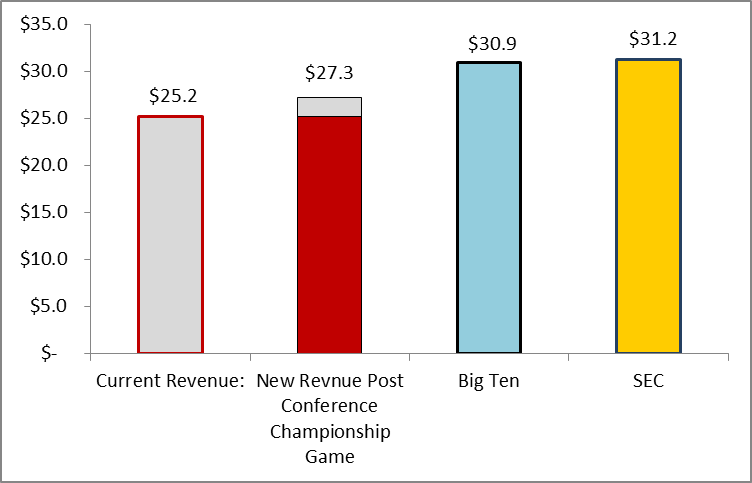
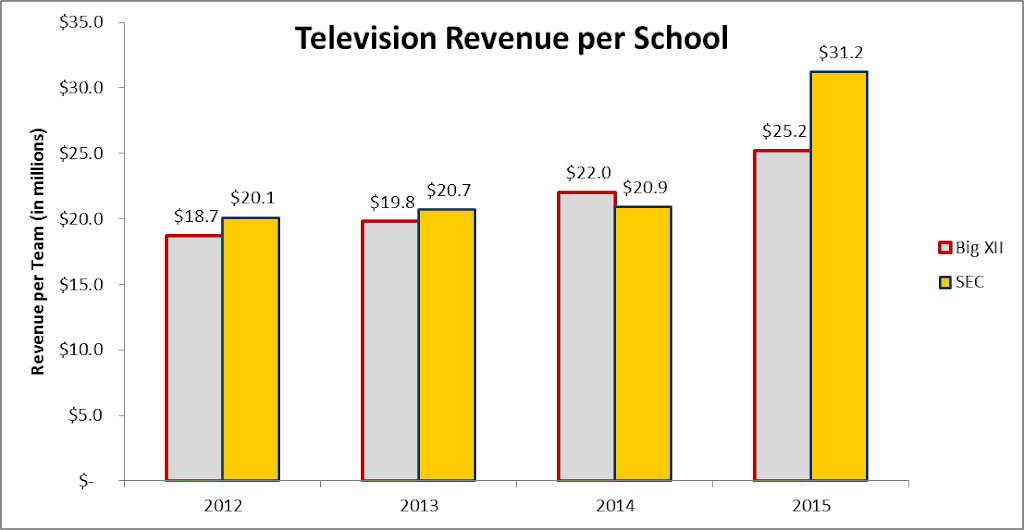
  • Current television revenue per school in the Big XII is $25.2 million vs. the SEC at $31.2 million
  • Texas and Oklahoma each make an estimated $40.2 million and $33.7 million respectively due to additional 3rd party television deals 
  • Adding two schools to the conference will need to help generate an additional $3.0 million per year per school in order to get the conference payout on par with the SEC ($31.2 million) and Big Ten ($30.9 million)
  • My Top Three Expansion Candidates: Houston, BYU, Cincinnati 
  • I didn’t discuss the complexities of 3rd party television deals (Tier III TV rights). That is for another blog post
 

Introduction

 
Between 2010 and 2013, the Big XII was destabilized when Texas A&M, Missouri, Colorado, and Nebraska all left for greener pastures. The big catalyst for fleeing was the perceived unequal power of Texas and Oklahoma which ultimately led to unequal distribution of TV revenue.  Six years later, it is safe to say that the Big XII is at another crossroads, and the topic of discussion once again is conference realignment/expansion. 
 
If recent news is to be believed, the Big XII conference has narrowed its list of potential candidates for expansion down to fittingly 12 Group of Five candidates. And given Houston’s performance against Oklahoma yesterday afternoon, the chatter is only going to intensify.


The 12 Hopefuls

 
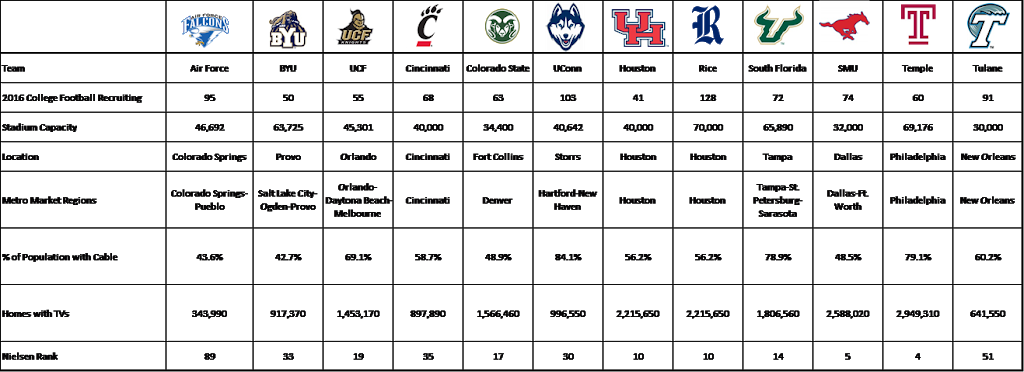
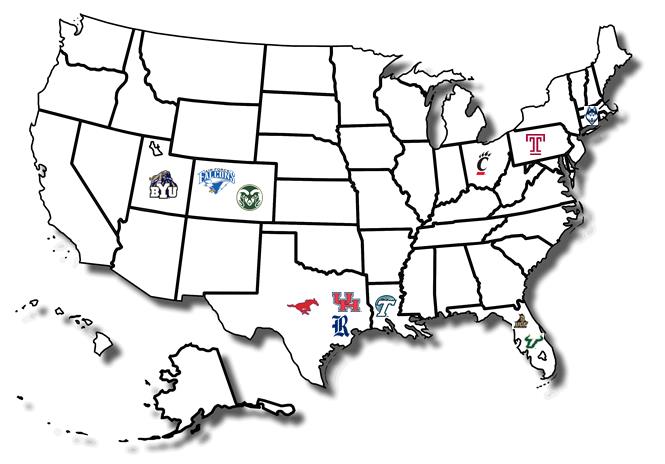
The potential schools stretch as far west as BYU to as far south as UCF and South Florida. And given where current member school West Virginia is located, it is not surprising that Cincinnati and Temple are being considered due to geographical reasons. I have compiled “resumes” of the 12 potential candidates for expansion (see chart below):


The tentative plan is to access the viability of each of the 12 schools, and the representatives of each of the 10 Big XII schools will decide what to do at the board of directors meeting on October 17th of this year. 
 
In this high risk game of conference realignment and television contracts, I believe it is important for the Big XII to consider the longer term ramifications of expansion and not jump into a knee jerk reaction, adding two “subpar” schools just in an effort to get back to 12 teams. Specifically, the two schools that the Big XII adds will need to at minimum add an additional $3.0 million in incremental television revenue per school to be worth the trouble.


Why This Time is Different than 2012 

 
On July 1, 2012 out of necessity, TCU and West Virginia became official members of the Big XII Conference. Both schools joined the Big XII after winning their conference championships the year before in football, and from a stability standpoint, the addition of these two schools was absolutely necessary to keep the conference from complete disintegration.
 
After surviving near annihilation, the Big XII member schools (specifically Texas) learned its lesson and voted to equally distribute Tier 1 and Tier II television revenues:


It’s hard to pinpoint exactly how much tangible value TCU and West Virginia brought to the Big XII. Over the past 3 years, Big XII television revenue has grown at a compound annual growth rate of 10.5%. And although its conference revenue is 19.2% less on a per school basis than the SEC (due to SEC network), there is absolutely no denying that revenue per school in the Big XII has stabilized and steadily grown. 
 
On top of this, unlike other conferences, the Big XII allows schools to make additional television revenue through their 3rd party deals. At this point, Texas, Oklahoma, West Virginia, and Kansas each make an additional $8.5 to $15.0 million per year.
 
Given where the Big XII is currently, this time expansion talk feels a bit different. Rather than being about survival and necessity, the Big XII now can take its time and figure out which two schools will help them create the most incremental value to the current ten member schools.


Deregulated Conference Championship Game Doesn’t Necessitate the Big XII Expanding

 
Under the new NCAA rules which passed earlier this year, the Big XII will be able to hold a conference championship game in football while retaining its 10-member structure[1]. Previous rules stated that conferences needed a minimum of 12 members to play a championship game between two division winners. Given this, the Big XII doesn’t necessarily need to get to 12 members to reap the benefits of the conference championship game.
 
Research has shown that even at 10-members a Big XII championship would net an incremental $1.7 million to $2.4 million per year for each school[2]. Although going to 12 teams may help bolster the credibility of their conference championship game, from an incremental revenue standpoint, the Big XII can gain an additional $1.7 to $2.4 million for each of its members per year simply by adding a conference championship game without adding two new members:


So given where the Big XII is, the question it must ask it itself is will the addition of the two new schools net more than $3.0 million per year in incremental revenue?


Do Two New Schools = $3.0 million extra per school each year?

 
Given the geographical variety of the 12 potential candidates for expansion, I believe it is important to access the likelihood that the two additional schools in question will add at least $3.0 million in value per year.
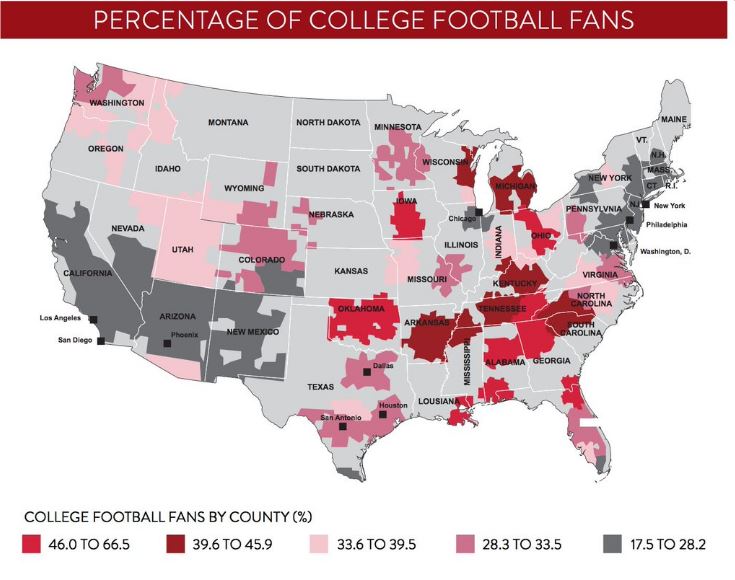
Using the most recent update from Nielsen Year in Sports (pdf can be found here) you can see the density of college football fans by region:
 
Not surprising, when you overlay the 12 candidates for potential expansion (see map below), you will see that a majority of these candidates are in states that have high density college football footprints:


When it comes to capturing incremental television revenue, it’s imperative that the two schools that Big XII officials choose have locations that are highly saturated by college football fans and have an expansive alumni base that stretches from coast to coast. Both these reasons give the Big XII leverage in their discussions with ESPN and Fox, and ultimately drive up the value of their television deals.
 
As you can see from the above two maps, three schools standout to me as candidates that meet these two qualities: Houston, Cincinnati, and BYU.
 
Each of these three schools has footprints in high density locations. Specifically, the Nielsen TV market rankings of each of these locations are 10th, 35th, and 33rdrespectively. On top of this, these three schools on paper seem to meet the criteria of having alumni that expand from coast to coast in a similar fashion the alumni from the Big Ten schools (as an aside, the BIG Ten is absolutely killing it when it comes to TV deal negotiations. See article here.) 


Conclusion

On October 17th when the Big XII gets together to decide the fate of its conference, it must keep in mind that the two schools they decide to add, must add at least $3.0 million in incremental television revenue per school to be worth the trouble. As the SEC and Big Ten have shown, 12 to 14 team conferences with their own conference network should net at least $30 million in revenue per school each year. Given where they Big XII currently is, expansion should only move forward if they can identify two schools that help them catch these two.

[1] WOLKEN, DAN. “NCAA members OK football championship games for all conferences.” 14 Jan. 2016. Web Retrieved 3 Sep. 2016

[2] CRUPI, ANTHONY. “Fox Sports Signs Up Six Big Ten Title Games in 2011-16.” 18 Nov. 2010. Web Retrieved 3 Sep. 2016


Are Leicester City sustainable Champions in a way the Blackburn Rovers never were?

Introduction

With Leicester City on the verge of winning the Premier League title, a lot has been made about their title run this year. The New York Times recently revered Leicester’s title campaign as “Soccer’s Most Remarkable Season” (see link here). The Guardian recently called Leicester’s campaign the “Greatest Underdog Story Ever Told” (see link here). 
 
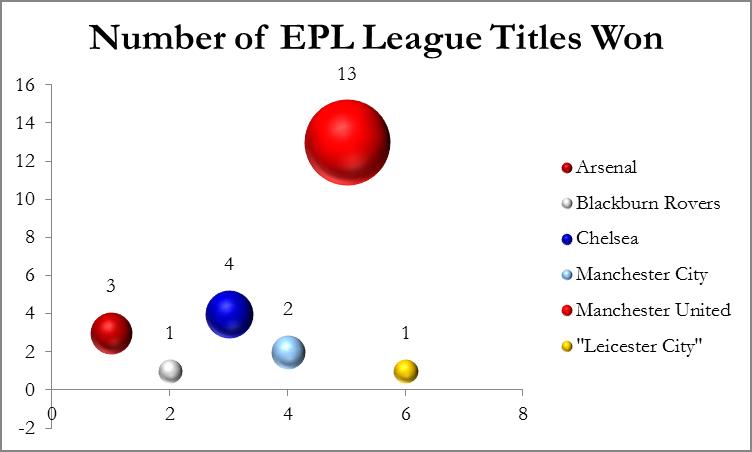
In the modern era of the Premier League, since 1992 there have only been 5 teams to win the league[1]:


  • Arsenal (3x champion): 1997-98, 2001-02, 2003-04
  • Blackburn Rovers(1x champion): 1994-95
  • Chelsea (4x champion): 2004-05, 2005-06, 2009-10, 2014-15
  • Manchester City (2x champion):  2011-12, 2013-14
  •  Manchester United (13x champion): 1992-93, 1993-94, 1995-96, 1996-97, 1998-99, 1999-00, 2000-01, 2002-03, 2006-07, 2007-08, 2008-09, 2010-11, 2012-13
  • “Leicester City” (1x champion): 2015-16 (pending)
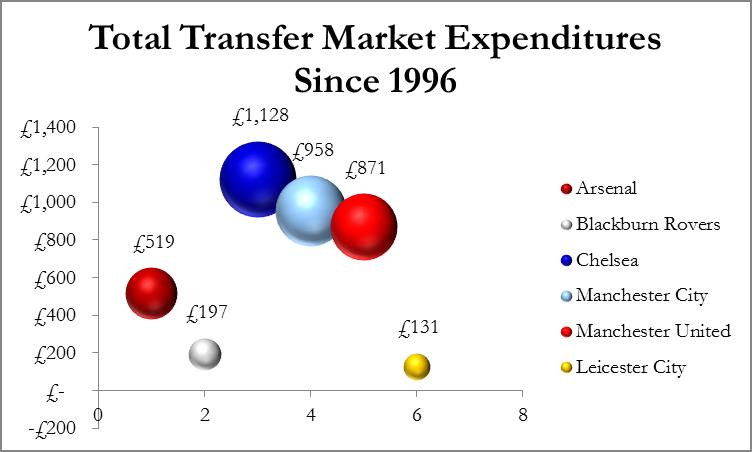
The past 20 years, The Big Four of Arsenal, Chelsea, Manchester City, and Manchester United have spent a combined £3.48 billion in the transfer markets which has led to one of the Big Four winning 96% of the Premier League titles (22 of the 23) since 1996[2].


Looking to the future, as Leicester City stands on the brink of breaking this dominance and making Premier League history much in the same manner that Blackburn Rovers did in 1994-95, the question remains can they sustain their excellence much in a way that Blackburn Rovers was unable to do?
 

What Happens Next? A Mass Exodus of Players?

There is simply no question that Leicester City’s success this year has been remarkable and as a fan of sports I have to admit that I found myself rooting hard for them each week. But a direct result of this success has been a significant increase in the valuations of most of their players. And this increase in valuation leads to increased interest from the Big Four clubs.
 
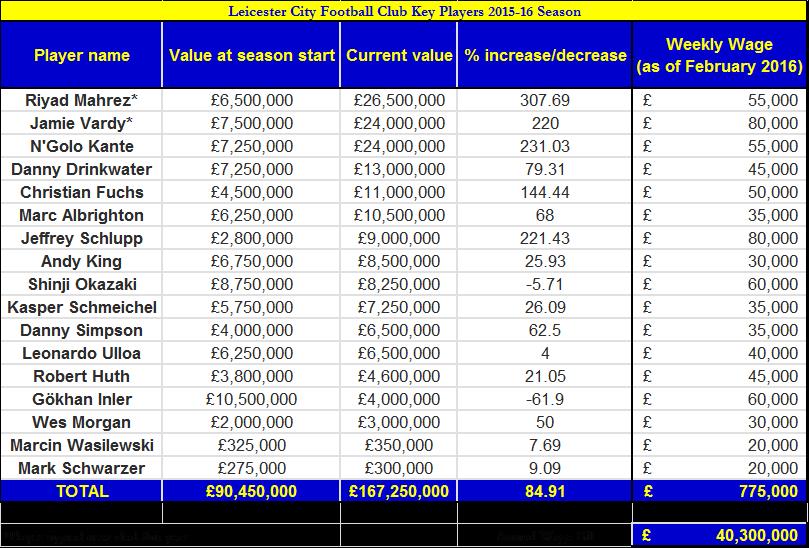
This season alone, Leciester City’s core group’s value (as shown below) has risen an estimated 84.9% this year[3]:


After Blackburn Rovers won the league there was a mass exodus of players, and their results began to slip. Four years later, Blackburn Rovers were relegated from the Premier League to Division One in the 1998-99 campaign. In a similar vein to Leicester City, Blackburn Rovers saw their player valuations skyrocket, and they were unable to avoid being pulled part by the bigger clubs who could afford to repeatedly break transfer and wage records to lure star players away. And based on recent reports regarding N’Golo Kante (see here) the summer exodus may be on its way…
 

Champions of England = More Money for Key Players… But Will it Be Enough?

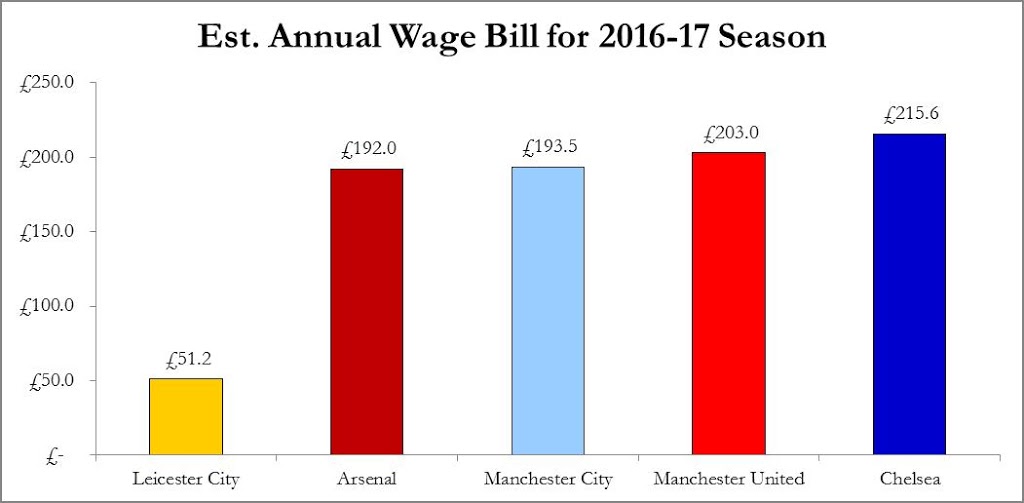
By winning the Premier League, Leicester City stand to pocket roughly £90.6 million which is +27% more than they pocketed last year for their 14thplace finish (£71.6 million)[4]. Given this windfall, there would be room for Leicester City to comfortably increase their annual wage bill on their Key Players from £40.3 million to £51.2 million.
 
The following key players’ new wages would look something like this (assuming everyone got their equal share):


But even at these elevated levels, the weekly wages are far less than the wages being paid at the Big Four. Specifically, this coming year alone, Chelsea, Manchester United, Manchester City, and Arsenal will have estimated annual wage bills of £216, £203, £194, £192 million respectively. 


On average, the Big Four have the ability to pay anywhere from 3.8x to 4.2x what Leicester City can pay. Given this, the Big Four could easily pay someone like Jamie Vardy, N’Golo Kante , or Riyard Mahrez £140,000 per week. Shit, Chelsea currently pays Diego Costa and Eden Hazard £185,000 and £200,000 per week to come in 10th.
 
Even though Leicester City will be playing in Champions League next season, I don’t believe it will be enough to keep their squad intact. For players like Jamie Vardy, N’Golo Kante, and Riyard Mahrez, they will be able to more than double their weekly wages at any of the Big Four clubs (if their intent is to stay in England). Money talks far more than Tuesday night’s in the Champions League.
 
So while I don’t predict the same massive exodus of all of players that occurred at Blackburn Rovers after the 1994-95 season, Leicester City will see some turnover in key positions for which, they will be highly compensated (I estimate that the transfers of Vardy, Kante, and Mahrez will easily net Leicester City £85.7 to £104.3 million).
 

But Leicester City is Different to Blackburn Rovers in One Key Way?

Given the significant valuation increases and the lack of weekly wages compared to the Big Four clubs for their key players, it seems on paper that Leicester City will struggle to keep their key players much in a similar fashion to Blackburn Rovers.  But Leicester City is different to Blackburn Rovers in one key way: The Foxes have a Thai billionaire owner
 
 
In 2010, Leicester City was bought for £39 million by Vichai Srivaddhanaprabha, a Thai billionaire owner:


For those of you that have watched Leicester City this year, you may or may not have seen his helicopter on the pitch at King Power Stadium at the end of each match:


But more importantly than his fashionable helicopter, Vichai Srivaddhanaprabha has BIG ambitions for Leicester City even before this season. He declared after the 2013-14 season, he would willingly spend £180 million to break into the top 5 in the next three years, and since he bought the club, Leicester City have spent roughly £77 million on transfers. To put this in some perspective, since 1996 Leicester City have spent a grand total of £131 million on transfers.
 
So unlike Blackburn Rovers, Leicester City has a very rich owner that is on par with some of the bigger clubs. And when all is said and done, Vichai Srivaddhanaprabha will willingly dig into his deep pockets in an attempt to build upon the success of the 2015-16 campaign. With an estimated net worth of $2.9 billion[5]Khun Vichai, as he is often called, will be the reason Leicester City don’t disappear in the similar fashion that Blackburn Rovers did many decades ago.
 
Enjoy the Leicester City miracle for what it truly is… an underdog story but be prepared… The Foxes aren’t disappearing anytime soon.


[1]TOTALSPORTEK2. “List of English Premier League Winners Since 1992.” 15 Aug. 2015. Web Retrieved 30 Apr. 2016

[2] http://www.transfermarkt.co.uk/

[3] THE MIRROR. “Football Manager reveals staggering amount Leicester City’s title chasers’ value has rocketed this year.” 18 Feb. 2016. Web Retrieved 30 Apr. 2016
[4] TOTAL SPORTEK. “(Predicted) Premier League Prize Money Table 2016 Season.” 16 Apr. 2016. Web Retrieved 30 Apr. 2016
[5] http://www.forbes.com/profile/vichai-srivaddhanaprabha/
 

Chelsea F.C. need a new stadium as Roman Abramovich thinks long-term

Introduction

With all of the turmoil surrounding Chelsea F.C. due to the 2nd sacking of Jose Mourinho, and given the uncertainty regarding the future direction of this club, I wanted to take a serious look at the long-term financial sustainability of Chelsea F.C. The recent 2016 Deloitte Football Money League rankings have placed Chelsea F.C. 8th overall at an estimated £323 million in revenue for the 2014-15 season[1]. This position is down 1 spot from last year’s ranking of 7th and down 4 spots from their highest all-time ranking of 4th in the 2006-07 season.
 
Since Roman Abramovich took control of Chelsea F.C. in 2003, the Blues have seen their annual revenue grow from £110 million in 2003 to £314 million for the 2014-15, a compound annual growth rate of approximately +8.42%. But during this 13 year period, the Blues have only posted positive operating profits twice (in 2011-12 the year the won Champions League and 2013-14). In fact, the average operating loss during this 12 year period (including the 2 years of profit) is approximately -£57 million. Despite winning the Barclays Premier League and the Capital One Cup last year, Chelsea F.C. racked up a £23.1 million loss[2].


With Chelsea almost certain to miss next year’s Champions League (barring some dramatic/fantastic change in form), the Blues are in some jeopardy of slipping into financial uncertainty given their heavy reliance on non-controllable sources of income. The average financial hit to broadcasting revenue for failing to qualify for Champions League football has been estimated to be £35 million[3]. Furthermore, this lack of Champions League football will put a barrier on their ability to retain their top talent this summer, almost certainly forcing Chelsea F.C. to overhaul their player roster.
 
The easy answer is to simply just blame Chelsea F.C.’s forever growing wage bill with has grown at a compound annual rate of +10.9%[4]. But as you will see from this write up, there is far more to this story than simply reducing player wage bills. It is my opinion that the primary way for Chelsea F.C. to reduce its reliance on Champions League and to secure their long-term financial position is to invest in a larger stadium.
 

Revenue Sources for a European Football Club

The single most important measure of whether or not a football club has a puncher’s chance at financial sustainability is their ability to generate revenue from multiple sources. Traditionally, football clubs rely upon the following sources of revenues:
 
1.       Match day revenue including tickets and corporate hospitality sales
2.       Broadcast rights including distributions from participation in domestic leagues, cups, and European club competitions
3.       Other commercial sources including sponsorships, merchandising, stadium tours, and other commercial operations
 
In the current world of European football, revenue sources have drastically changed over the last ten years with a majority of revenue coming from non-match day sources. This year’s Deloitte Football Money League report marks the lowest ratio of total revenue that has been comprised by match day revenue. The split between the three principle revenues sources for the majority of European football clubs is as follows[5]:
 
    • Match day generates 19% of total revenue
    • Broadcast rights generate 40% of total revenue
    • Other commercial sources generate 41% of total revenue.
In contrast for Chelsea F.C., since the 2009-10 season, the Blues have driven 27% of their revenue from match day, 41% from broadcast rights, and 32% from other commercial sources[6]. Different to some of the other elite European football clubs, Chelsea F.C. is far more reliant upon match day revenue. With such a large sum of their revenue driven by match day, it is critical that Chelsea start actively planning for the long term and focus on the single most controllable and important source of income to the club: match day revenue.
 

Current Chelsea F.C. Match Day Revenue

Chelsea F.C. currently plays its home matches at Stamford Bridge which has a max capacity of 41,798 and in the current season, the Blues average attendance is 41,516[7]. Opened in 1877, max capacity at Stamford Bridge ranks 8th overall in the Barclay’s Premiere League while average attendance ranks 7th.
 
 
When you compare Stamford Bridge to Chelsea’s closet financial rivals, United, City, and Arsenal all have stadiums that are much larger than the Blues’:
 
    •  Manchester United’s average attendance at Old Trafford is 75,345 with a max capacity of 75,635. United’s home ground is 1.82 times larger than Stamford Bridge
    • Arsenal’s average attendance at Emirates Stadium is 59,951 with a max capacity of 60,260. Arsenal’s home ground is 1.45 times larger than Stamford Bridge
    • Manchester City’s average attendance at Etihad Stadium is 53,897 with a max capacity of 55,097. City’s home ground is 1.33 times larger than Stamford Bridge
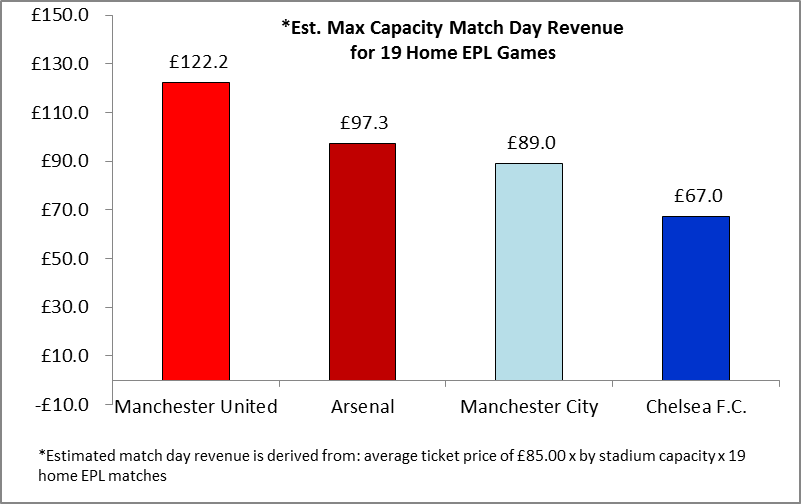
With Chelsea’s current size limitations, at an average price of £85 per ticket, Chelsea F.C. is making roughly £3.5 million per home game and roughly £67.0 million annually for 19 home premier league matches. 


Compared to its closet financial rivals, Chelsea F.C. makes £2.9 million less than United, £1.6 million less than Arsenal and £1.2 million less than City per home game. Given this discrepancy in home ground revenue, Chelsea F.C. is missing out on approximately £22 million to £30 million in match day revenue annually. 
 
An absolute key component to Chelsea’s long-term financial stability will be to increase match day revenue on part with Arsenal and the two teams from Manchester.
 
 
A Minimum 60,000+ Capacity New Stadium is a Must
As I mentioned before, the average cost of missing out on Champions League football is £35 million, and this year’s performance by Leicester City and Tottenham shows that guaranteed top four finishes are no longer the norm for Chelsea F.C (just ask Liverpool F.C). Although this season might be a “one-time” aberration, it is absolutely vital for Chelsea F.C. to develop a bigger home ground to solidify and secure the future success of this football club.
 
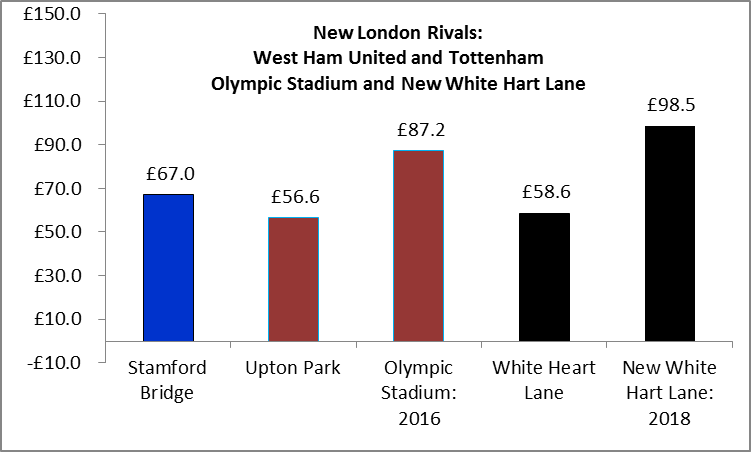
When you look to the east of London and the north of London, you see two clubs in West Ham United F.C. and Tottenham Hotspurs F.C. who fundamentally have taken serious strides to do as much. Both the Hammers and the Spurs have long-term established plans to increase their stadium capacities from the mid-35,000 range. West Ham will be moving to the 54,000 seat Olympic Stadium for the 2016-17 season, while Tottenham will build a 61,000 capacity stadium to replace their current home ground for the 2018-19 season. 


*West Ham United’s new 54,000 capacity home ground for the 2016-17 season. Their current home ground of Upton Park only holds 35,016[8]

*New White Hart Lane will cost £750 million and will seat well over 61,000 fans starting in 2018. Current White Hart Lane only seats 36,284[9]

Both of these aggressive moves will put West Ham United and Tottenham Hotspurs F.C. in a far more advantageous and financial stable position than the Blues:
 
 
I estimate that West Ham match day revenue will grow by +54% to £87 million while Tottenham match day revenue will grow by +68% to almost £100 million annually. It’s a no-brainier whatsoever that Roman Abramovich needs to double down on his belief in Chelsea F.C. and build the club a new stadium. But it wouldn’t be Chelsea F.C. if there wasn’t some wrinkle to this story…
 

What Is Preventing Chelsea F.C. from Building the 60,000+ Stadium of their Dreams?

In the 1970’s and 1980’s Chelsea F.C. suffered serious financial setbacks following a large scale attempt to renovate Stamford Bridge. In order to keep the club afloat, Stamford Bridge freehold (rights of ownership to the property) was sold to a property developer by the name of Marler Estates. In doing do, Chelsea F.C. ceded control of their own home ground.
 
This arrangement continued through the early 90’s until a group of Chelsea F.C. lifelong supporters founded the Chelsea Pitch Owners (CPO) and purchased the Stamford Bridge freehold, the pitch, and the Chelsea F.C. name. This move was made to ensure that Stamford Bridge could never again be sold to property developers not related to the club. At the same time though, it also ensured that any talk of a new stadium had to be passed by 75% of the members of the CPO.
 
***A quick aside… Guess who is the president of the Chelsea Pitch Owners? The one and only captain John George Terry***
 
This unique relationship between Chelsea F.C. and the CPO has put the club in a very tough position. They know that it is a must to increase the capacity of their home stadium, but the CPO have forced Chelsea F.C. to play their home games at Stamford Bridge or lose the right to use the Chelsea F.C. name (since the CPO own the rights to the name as well). So if you are forced to stay in your correct location but you know that you have to increase stadium capacity, what are you going to do Roman Abramovich?
 

Expand Stamford Bridge to 60,000+ and Move to Wembley Stadium in the short-term

Currently, Chelsea F.C. is in the planning and development stage of a 60,000+ expansion to their current home ground Stamford Bridge with the estimated cost of the project currently valued at £500 million[10]. During the three year period of construction starting in 2017, the Blues are planning to play their home games at Wembley Stadium which is a mere 10.6 miles from Stamford Bridge. Home matches at Wembley stadium will be restricted to 50,000 even though max capacity is 90,000, and the total annual cost to the Blues for rental of Wembley will be £20 million. The photo below is the current development design for the New Stamford Bridge by Swiss architects Herzog & de Meuron:
 

I have created a financial projection of this construction project and without question, this is absolute the right thing for the football club to invest in:


It still remains to be seen if this major redevelopment project will pass the major planning and economic obstacles that currently exist. But one thing is remarkably clear for Chelsea F.C…. In this day of rising Premiere League broadcast money and new upstart clubs like Leicester City, sustained match day revenue growth will have to be the primary means by which Chelsea F.C. ensures its financial future. With West Ham and Tottenham breathing down their necks, Chelsea’s current financial superiority is under pressure and a new stadium will go a long way to relieve some of this pressure.


[1]SPORTS BUSINESS GROUP. “Top of the table: Football Money League” Deloitte 1 Jan. 2016. Web Retrieved 1 Feb. 2016.

[2]Chelsea FC. “Financial results announced with FFP compliance maintained.” Chelsea FC Website. 23 Nov. 2015. Web Retrieved 2 Dec. 2015.
[3] KEEGAN, MIKE. “The cost of failing to qualify for the Champions League.” MailOnline. 17 Sept. 2015. Web Retrived 13 Feb. 2016.
[4] ZIEGLER, MARTYN. “Chelsea player wage bill the highest in the Premier League last season at £215.6m” Press Association. 8 Jan. 2016. Web Retrieved 1 Feb. 2016.
[5] SPORTS BUSINESS GROUP. “Top of the table: Football Money League” Deloitte 1 Jan. 2016. Web Retrieved 1 Feb. 2016.
[6] O’REILLY, LARA. “Samsung to Pull Chelsea FC Sponsorship: Turkish Airlines To Take Over With Larger Package.” Business Insider. 6 Oct. 2014. Web Retrieved 1 Feb. 2016
[7] SoccerSTATS.com. “Premiere League Home Attendance for 2015/16 Season.” Web Retrieved 9 Feb. 2016

[8] http://www.whufc.com/New-Stadium/Activities

[9] http://www.tottenhamhotspur.com/news/northumberland-development-project-updated-designs-and-plans-080715/

[10] DUBAS-FISHER, DAVID. “Chelsea Stamford Bridge expansion plans: Why £500 million is good value for Roman Abramovich.” 2 Jul. 2015. Web Retrieved 13 Feb 2016.